
Model Dating Guides
Follow the changes that belong to your exact Gibson family.
Free reference tool
Start here
Serial ranges are estimates. Cross-check valuable instruments before buying or selling.
Use our comprehensive tool to decode your Gibson serial number. Make sure to cross-reference features and parts using our advanced dating guides below, since serial numbers are not always 100 percent accurate. As always, feel free to reach out to us if you need help dating a guitar.
Jump straight to the chartsWritten and reviewed by Joe Dampt•Updated September 16, 2026
Quick Format Guide
| Number | Likely Systems | Compare |
|---|---|---|
| 3 to 6 digits | Vintage labels, FONs, ink stamps and reused ranges | Vintage Charts |
| 8 digits | 1970s decals or modern date codes | DecalsModern |
| 9 digits | Modern batch or 2014 to mid-2019 model-year format | 9-Digit Charts |
| Letter prefixes | A-prefix, FON, Custom Shop or special formats | A-PrefixSpecial Formats |
After the Serial Lookup
A serial number is a good start, but identifying a guitar’s model changes, original parts and construction will allow you to form a more accurate picture of its origin.
Browse More Gibson ResourcesFollow the changes that belong to your exact Gibson family.
Check original components that can support or challenge the serial result.
Compare construction details that are harder to replace than a knob or tuner.
Need Help Finding the Number?
The location and application method of a Gibson serial number will tell you which numbering system to use. Some Gibson guitars do not have a serial number. If yours does not, check for a Factory Order Number instead.
Look through the soundhole or f-hole. Note the label color and whether the number begins with a letter.
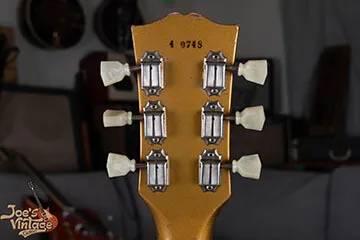
Common on 1950s solidbodies. The digits sit on top of the finish rather than being pressed into the wood.
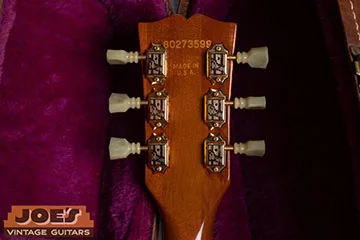
Check whether “Made in USA” appears below it. That detail separates many 1960s and 1970s sequences.
Quick answer
Most Gibson solidbody and semi-hollow guitars have a serial number on the back of the headstock. Vintage acoustics and hollow-body electrics may have it on an interior paper label visible through the soundhole or f-holes. Older instruments can also have a Factory Order Number stamped on bare wood inside the body.
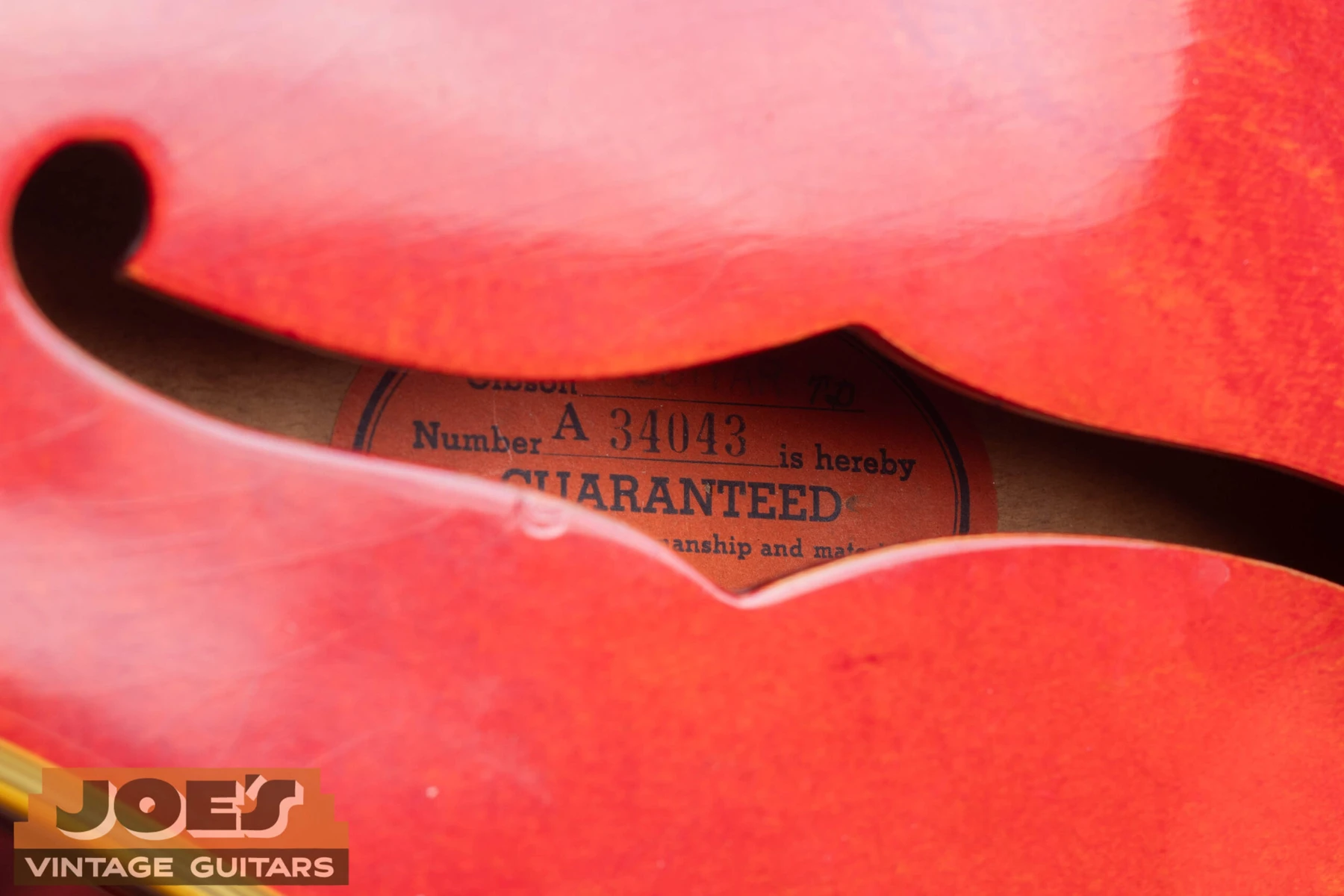
A 34043 is on the paper label, visible through the f-hole. This is the guitar’s serial number.
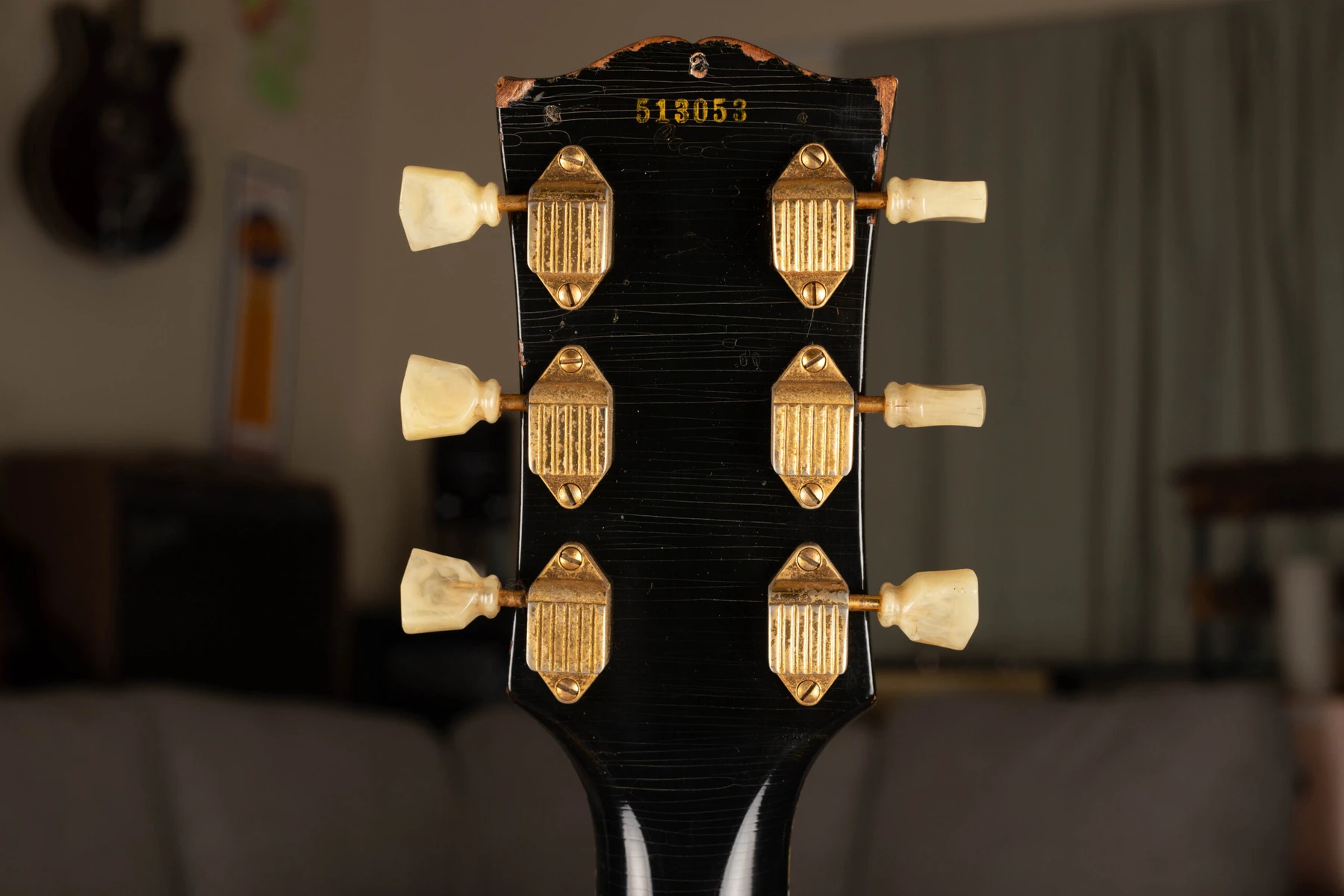
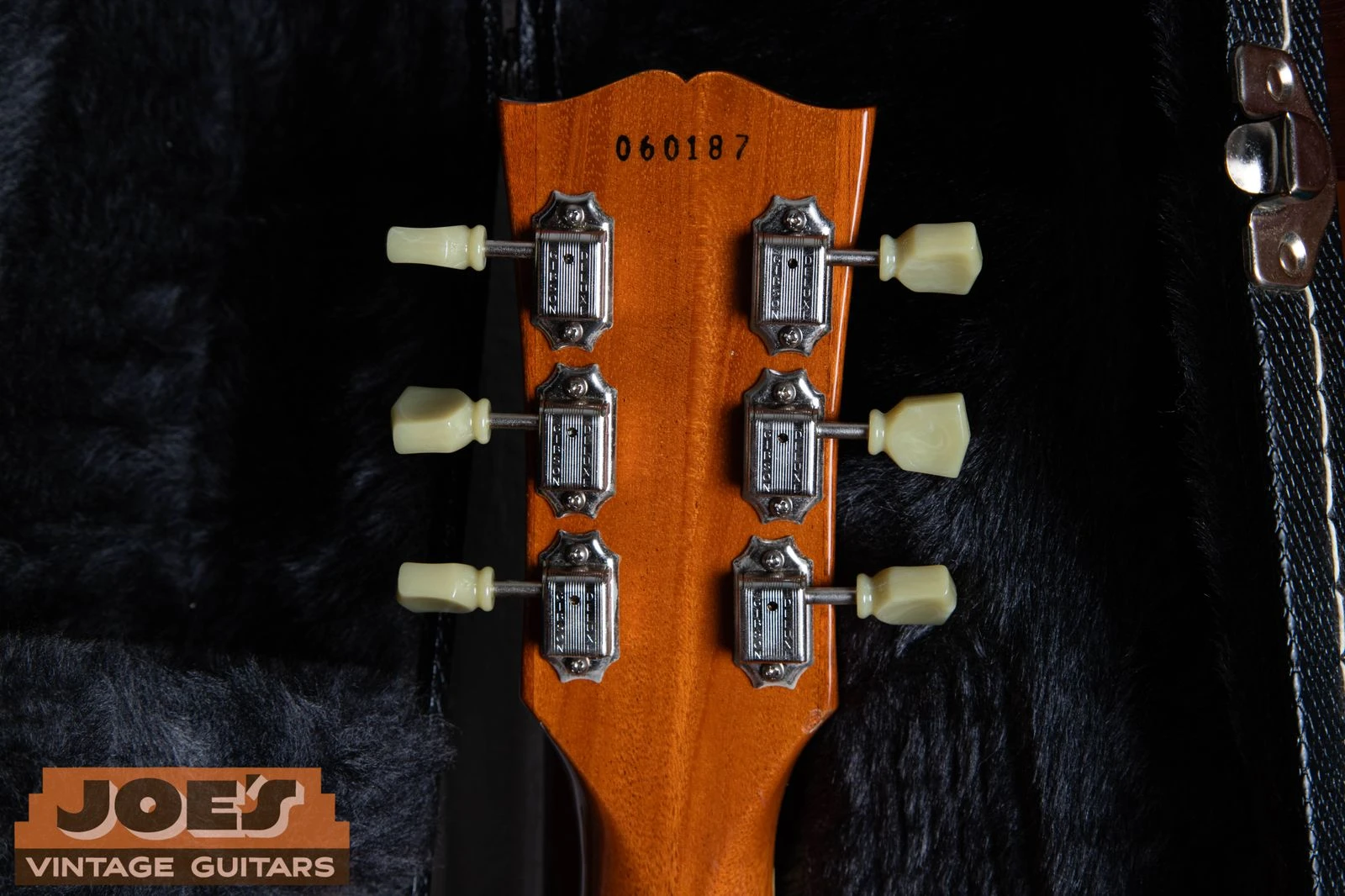
513053 is ink-stamped on the finished back of the headstock. This is a serial number, not an interior FON.
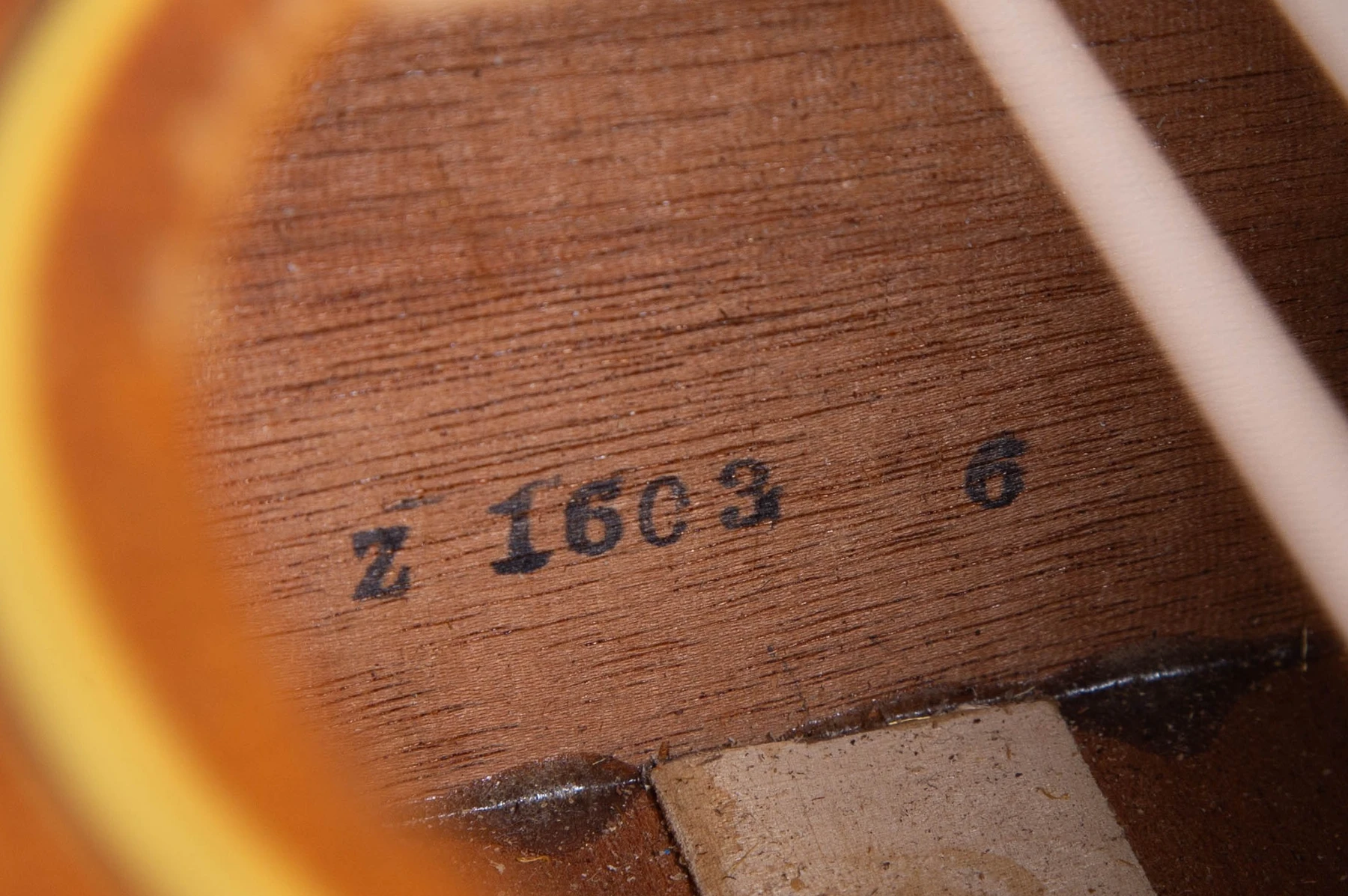
Z 1603 6 is ink-stamped directly on the bare interior wood.
Some older Gibsons have both numbers; others have only a FON. On older models carrying both, the FON was assigned at the start of production and the serial recorded later, before shipping. Check both against the guitar’s features rather than treating either as an exact completion date.
In the lookup tool, choose “Serial number” for the serial or “Factory Order No.” for the FON. If you have both, enter each separately.
The full reference
Serial number charts
Gibson changed numbering systems repeatedly, and some ranges overlap. Match the number’s format, location, and application method before choosing a chart.
1902 to 1961
Usually stamped inside the body. A FON may identify a production batch even when the guitar has no serial number.
Z 1603 6 is stamped on the wood, not a paper label. Z is the 1952 FON prefix; the other numbers identify the batch and position within it.
| Period | FON range | Note |
|---|---|---|
| 1902 to 1916 | 1 to 3,650 | Numbers generally increased, but counting could start over. A smaller number does not always mean an older guitar. |
| 1917 to 1923 | 11,000 to 12,000 | These numbers suggest this period, but the range is approximate and does not give an exact year. |
| 1924 to 1925 | 11,000A to 11,250A | The letter A comes after the digits, as in 11000A. In this earlier format, A does not mean 1935. |
| 1925 to 1931 | 8,000 to 9,999 | Uses digits without a letter. Similar numbers occur in other periods, so check the guitar’s features. |
| 1931 to 1933 | 1 to 890 | Counting started again at low numbers. These can overlap earlier numbers, so use other clues to confirm the date. |
| 1934 | 1 to 1,500 | These numbers have no year-code letter. Gibson introduced letters to identify the year in 1935. |
| Suffix | Year |
|---|---|
| A | 1935 |
| B | 1936 |
| C | 1937 |
| D | 1938 |
| E | 1939 or 1941 |
| F | 1940 |
| G | 1941 |
| H | 1942 |
| Year | Approximate FON |
|---|---|
| 1942 | 907, 910, 923; 2,004 to 2,005; 7,000s |
| 1943 | 900 to 2,200 |
| 1944 | 2,200 to 2,900 |
| 1945 | 100 to 1,000 |
| 1947 | 700 to 1,000 (unreliable) |
| 1948 | 1,100 to 3,700 |
| 1949 | 2,000 to 2,999 |
| 1950 | 3,000 to 5,999 |
| 1951 | 6,000 to 9,999 |
| Prefix | Year |
|---|---|
| Z | 1952 |
| Y | 1953 |
| X | 1954 |
| W | 1955 |
| V | 1956 |
| U | 1957 |
| T | 1958 |
| S | 1959 |
| R | 1960 |
| Q | 1961 |
Use the first suffix letter: If the FON has two letters as a suffix rather than one, use the first of the two letters to date the guitar. For example, if the FON is 1247CG, the C is used for dating, so the guitar dates to 1937.
For a J-200 with an interior FON, compare the number with the J-200 model history and its construction changes.
1903 to 1947
Sequential serials printed or written on the oval white label. Ranges are approximate and should be read with the instrument’s features. Some later white-label serial numbers have an A prefix. If yours does, continue to the A-prefix chart.
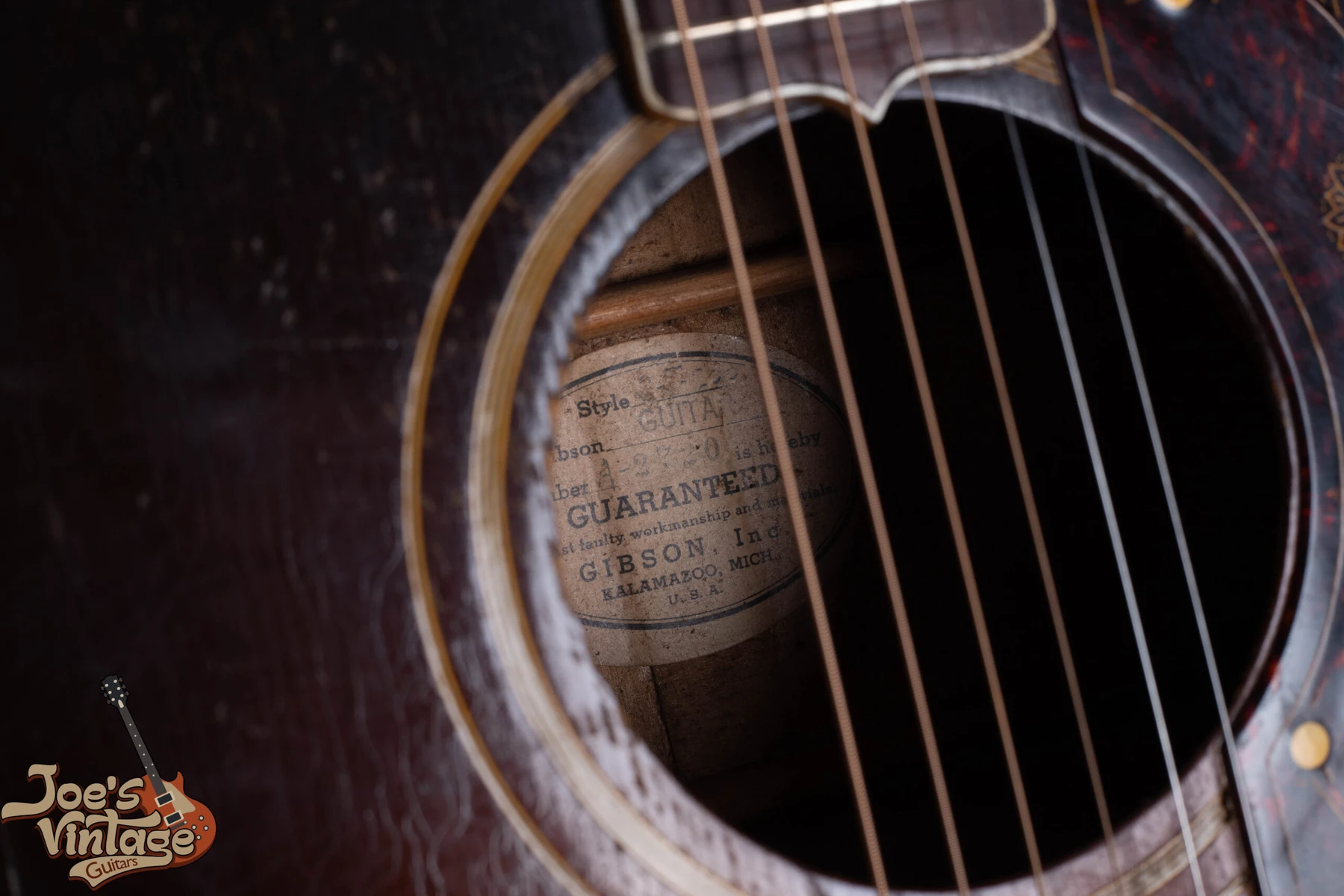
This later white label carries an A-prefix number. It is not a number-only example for the early chart below. Check the prefix as well as the paper color.
| Year | Serial range | Year | Serial range |
|---|---|---|---|
| 1903 | 1 to 1,150 | 1926 | 82,701 to 83,600 |
| 1904 | 1,151 to 1,850 | 1927 | 83,601 to 85,400 |
| 1905 | 1,851 to 2,550 | 1928 | 85,401 to 87,300 |
| 1906 | 2,551 to 3,350 | 1929 | 87,301 to 89,750 |
| 1907 | 3,351 to 4,250 | 1930 | 89,751 to 90,200 |
| 1908 | 4,251 to 5,450 | 1931 | 90,201 to 90,450 |
| 1909 | 5,451 to 6,950 | 1932 | 90,451 to 90,700 |
| 1910 | 6,951 to 8,750 | 1933 | 90,701 to 91,400 |
| 1911 | 8,751 to 10,850 | 1934 | 91,401 to 92,300 |
| 1912 | 10,851 to 13,350 | 1935 | 92,301 to 92,800 |
| 1913 | 13,351 to 16,100 | 1936 | 92,801 to 94,100 |
| 1914 | 16,101 to 20,150 | 1937 | 94,101 to 95,200 |
| 1915 | 20,151 to 25,150 | 1938 | 95,201 to 95,750 |
| 1916 | 25,151 to 32,000 | 1939 | 95,751 to 96,050 |
| 1917 | 32,001 to 39,500 | 1940 | 96,051 to 96,600 |
| 1918 | 39,501 to 47,900 | 1941 | 96,601 to 97,400 |
| 1919 | 47,901 to 53,800 | 1942 | 97,401 to 97,700 |
| 1920 | 53,801 to 62,200 | 1943 | 97,701 to 97,850 |
| 1921 | 62,201 to 69,300 | 1944 | 97,851 to 98,250 |
| 1922 | 69,301 to 71,400 | 1945 | 98,251 to 98,650 |
| 1923 | 71,401 to 74,900 | 1946 | 98,651 to 99,300 |
| 1924 | 74,901 to 80,300 | 1947 | 99,301 to 99,999 |
| 1925 | 80,301 to 82,700 |
For hollowbody electrics, use the ES-125 guide or ES-175 guide to check whether the model and features agree with the label.
1947 to 1961
A-prefix serial numbers are found on white or orange interior labels. On rare occasions, I have seen factory Gibson acoustic guitars from the late 1960s and early 1970s with an impressed A-prefix serial number on the back of the headstock. These impressed A-prefix numbers have no known dating system. The chart below refers only to serial numbers on an interior label.
A 34043 is the complete serial. Keep the letter when looking it up; these digits are a sequence, not a split year-and-day code.
| Year | Serial range | Year | Serial range |
|---|---|---|---|
| 1947 | A100 to A1,305 | 1955 | A18,666 to A21,910 |
| 1948 | A1,306 to A2,665 | 1956 | A21,911 to A24,755 |
| 1949 | A2,666 to A4,410 | 1957 | A24,756 to A26,820 |
| 1950 | A4,411 to A6,596 | 1958 | A26,821 to A28,880 |
| 1951 | A6,597 to A9,420 | 1959 | A28,881 to A32,285 |
| 1952 | A9,421 to A12,460 | 1960 | A32,286 to A34,645 |
| 1953 | A12,461 to A17,435 | 1961 | A34,646 to A36,147 |
| 1954 | A17,436 to A18,665 |
Match the serial to the right model: the Byrdland, ES-225 and 1959 ES-335 guides explain different construction and hardware clues within this period.
1953 to 1961
A five- or six-digit number inked on the back of the headstock. The first digit gives the year. In rare instances, a four-digit ink stamp appears on late-1958 Les Paul Juniors and Specials. These typically fall in the 6000 to 7000 range.
513053 is printed in yellow ink on a 1955 Les Paul Custom. The number sits on the surface; it is not pressed into the wood. Reissues can imitate this appearance.
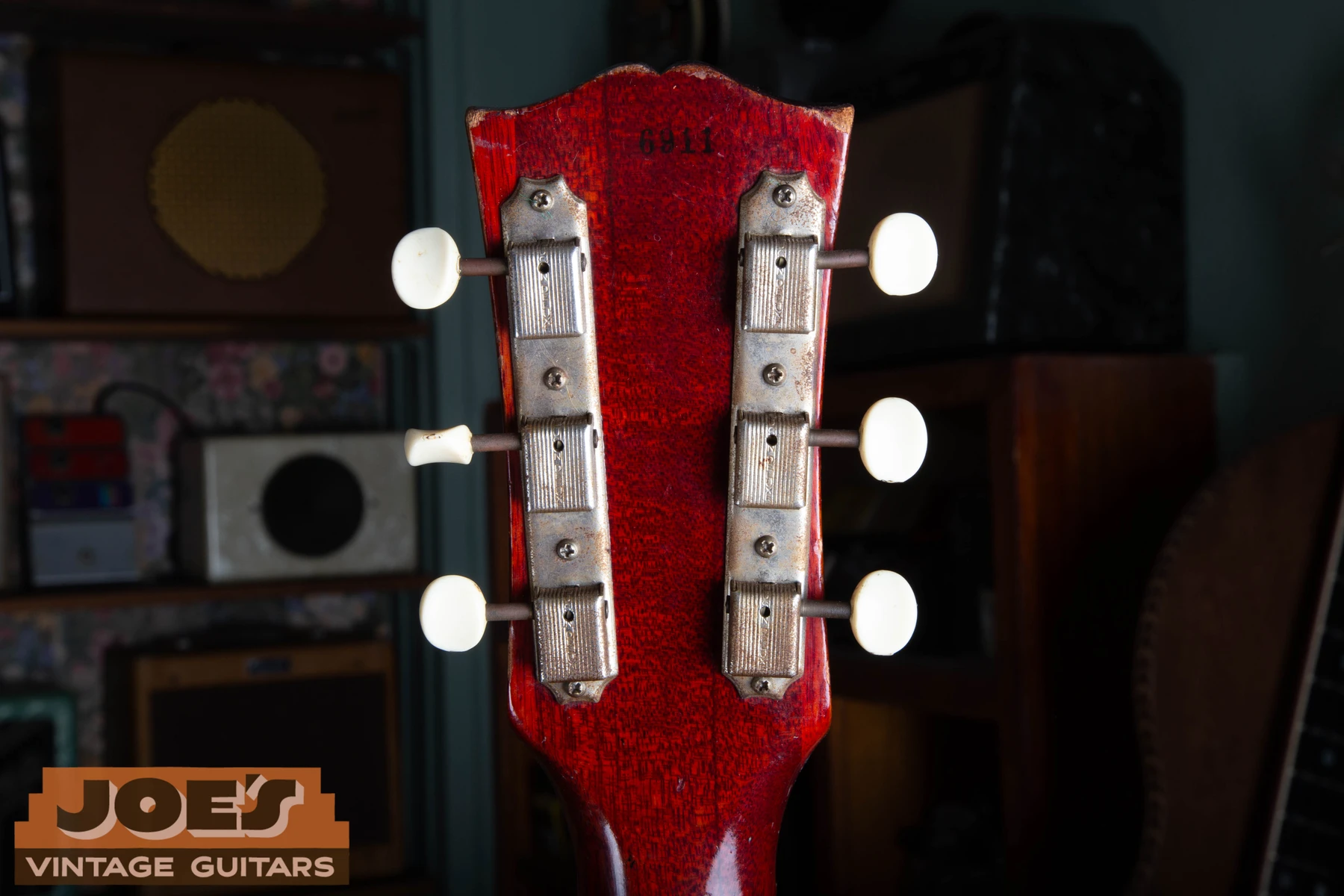
6811 is a rare four-digit ink stamp on a late-1958 Les Paul Junior. Some late-1958 Juniors and Specials have four-digit numbers in the 6000 to 7000 range.
Original 1952 Les Pauls normally have no serial. Do not date a 2-leading ink stamp as 1952 without individual verification. Rare 1961 instruments can have a 1-leading ink stamp; confirm the model and construction.
Use the Les Paul family dating guide for model-specific changes. The Les Paul Junior and TV model guides give closer comparisons for those instruments.
1961 to 1970
Numbers were stamped directly into the wood, then finished. These numbers can sometimes be hard to see, especially on darker finishes. Guitars made before 1970 do not have a “Made in USA” stamp underneath the serial number. Numbers from this era were often reused, so cross-check them with other dating features.
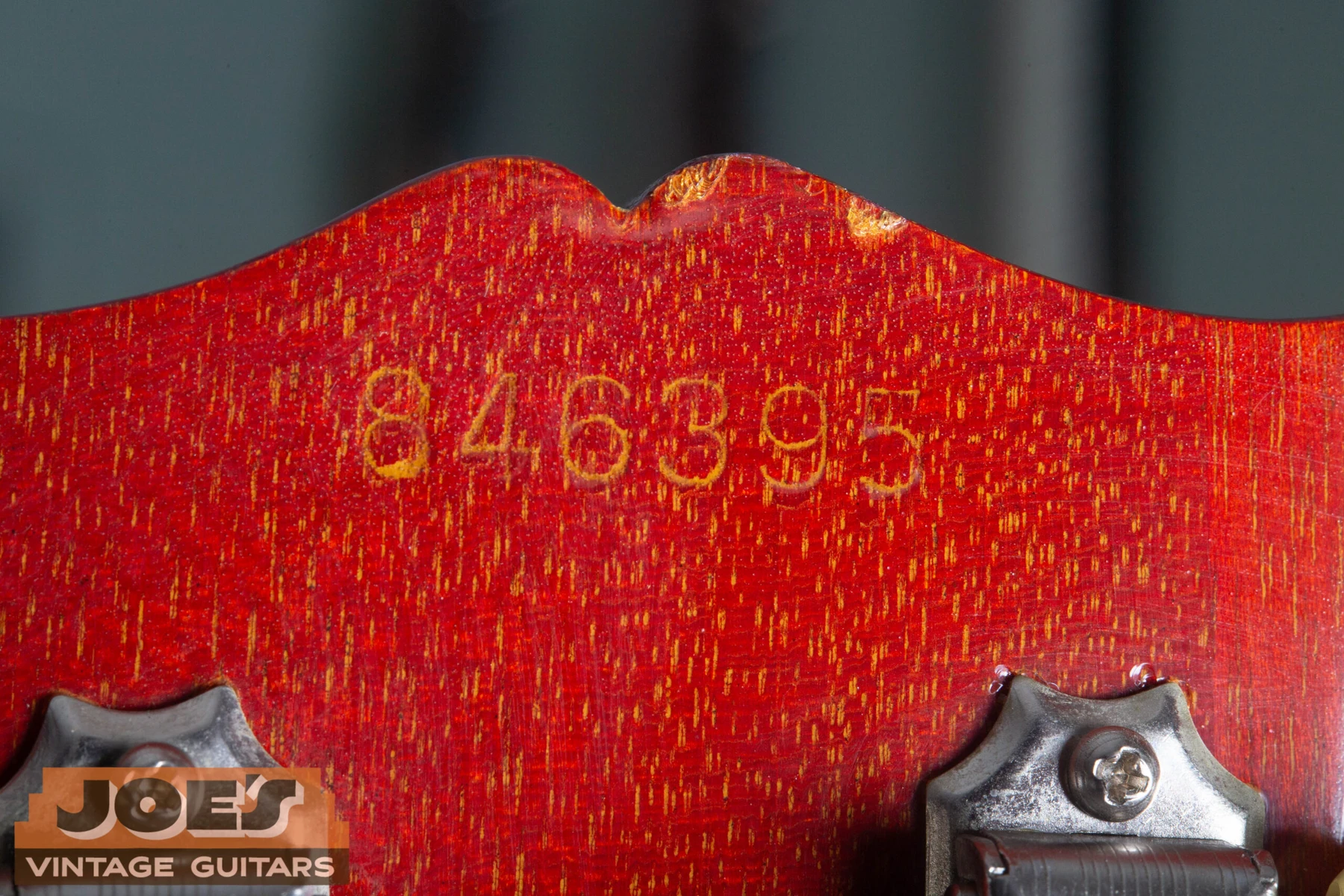
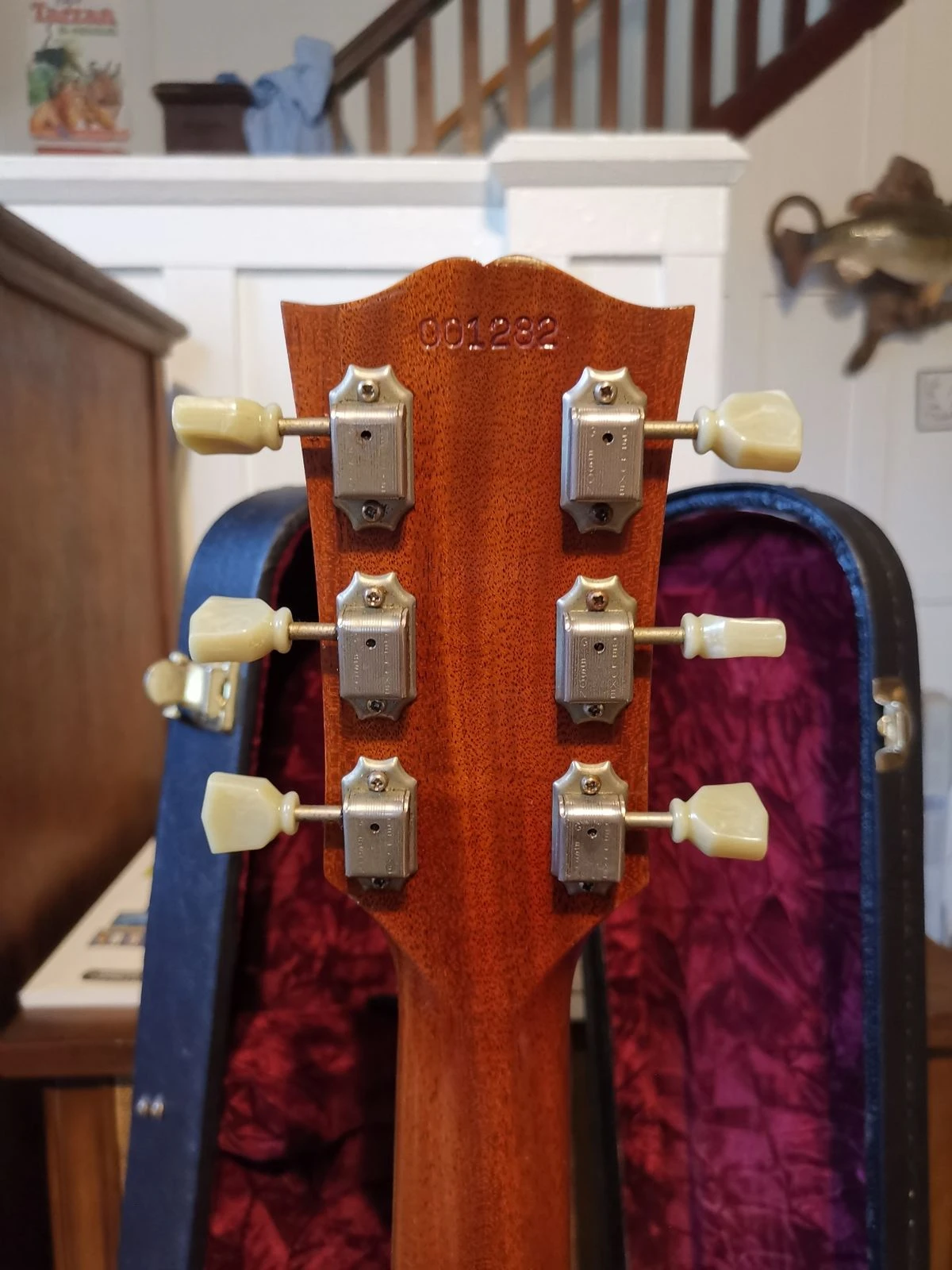
This serial number corresponds to 1966 and 1969. We cross-referenced it with the knobs, neck construction, tuners and logo to determine that it was a 1966.
| Serial range | Possible year(s) | Serial range | Possible year(s) |
|---|---|---|---|
| 0100 to 42440 | 1961 | 406667 to 409670 | 1966, 1967 or 1968 |
| 42441 to 61180 | 1962 | 409671 to 419999 | 1966 |
| 61450 to 64222 | 1963 | 420000 to 429193 | 1966 |
| 64240 to 71040 | 1964 | 500000 to 500999 | 1965, 1966, 1968 or 1969 |
| 71041 to 96600 | 1962, 1963 or 1964 | 501009 to 501600 | 1965 |
| 96601 to 99999 | 1963 | 501601 to 501702 | 1968 |
| 000001 to 099999 | 1967 | 501703 to 502706 | 1965 or 1968 |
| 100000 to 106099 | 1963 or 1967 | 503010 to 503109 | 1968 |
| 106100 to 106899 | 1963 | 503405 to 520955 | 1965 or 1968 |
| 109000 to 109999 | 1963 or 1967 | 520956 to 530056 | 1968 |
| 110000 to 111549 | 1963 | 530061 to 530850 | 1966, 1968 or 1969 |
| 111550 to 115799 | 1963 or 1967 | 530851 to 530993 | 1968 or 1969 |
| 115800 to 118299 | 1963 | 530994 to 539999 | 1969 |
| 118300 to 120999 | 1963 or 1967 | 540000 to 540795 | 1966 or 1969 |
| 121000 to 139999 | 1963 | 540796 to 545009 | 1969 |
| 140000 to 140100 | 1963 or 1967 | 555000 to 557999 | 1966 |
| 140101 to 144304 | 1963 | 558000 to 567400 | 1969 |
| 144305 to 144380 | 1964 | 570087 to 570643 | 1966 |
| 144381 to 149864 | 1963 | 570645 to 570755 | 1966 or 1967 |
| 149865 to 149891 | 1964 | 570857 to 570964 | 1966 |
| 149892 to 152989 | 1963 | 580000 to 580080 | 1969 |
| 152990 to 174222 | 1964 | 580086 to 580999 | 1966, 1967 or 1969 |
| 174223 to 176643 | 1964 or 1965 | 600000 to 606090 | 1966, 1967, 1968 or 1969 |
| 176644 to 250335 | 1964 | 700000 to 700799 | 1966, 1967 or 1969 |
| 250336 to 305983 | 1965 | 750000 to 750999 | 1968 or 1969 |
| 306000 to 310999 | 1965 or 1967 | 800000 to 800999 | 1966, 1967, 1968 or 1969 |
| 311000 to 320149 | 1965 | 801000 to 812838 | 1966 or 1969 |
| 320150 to 320699 | 1967 | 812900 to 819999 | 1969 |
| 320700 to 329179 | 1965 | 820000 to 820087 | 1966 or 1969 |
| 329180 to 330199 | 1965 or 1967 | 820088 to 823830 | 1966 |
| 330200 to 332240 | 1965, 1967 or 1968 | 824000 to 824999 | 1969 |
| 332241 to 348092 | 1965 | 828002 to 858999 | 1966 or 1969 |
| 348093 to 349100 | 1966 | 859001 to 895038 | 1967 |
| 349121 to 368638 | 1965 | 895039 to 896999 | 1968 |
| 368640 to 369890 | 1966 | 897000 to 898999 | 1967 or 1969 |
| 370000 to 370999 | 1967 | 899000 to 899999 | 1968 |
| 380000 to 385309 | 1966 | 900000 to 909999 | 1970 |
| 390000 to 390998 | 1967 | 910000 to 999999 | 1968 |
| 400001 to 406666 | 1966 |
The leading zero matters. 018875 is a different serial number than 18875.
Original pot codes and PAF or Patent Number pickups can help separate overlapping years. For an ES-335, compare the 1962, 1966 and 1968 ES-335 guides.
1970 to 1977
Most 1970s examples have “Made in USA” below a six-digit impressed serial. Short-lived eight-digit decals followed before the modern format.
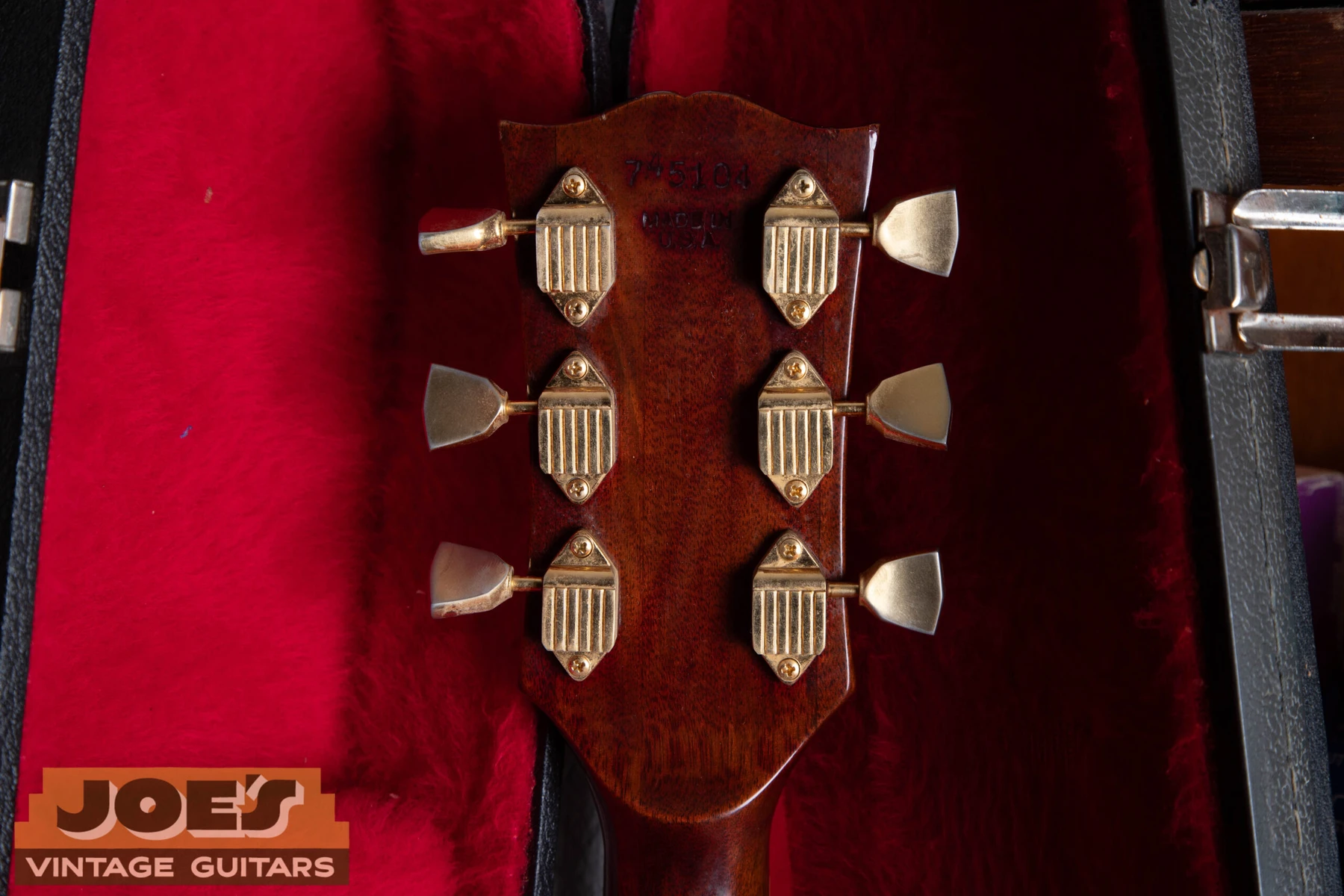
745104 and “Made in USA” are pressed into the wood. Note the six-digit serial and separate country-of-origin stamp.
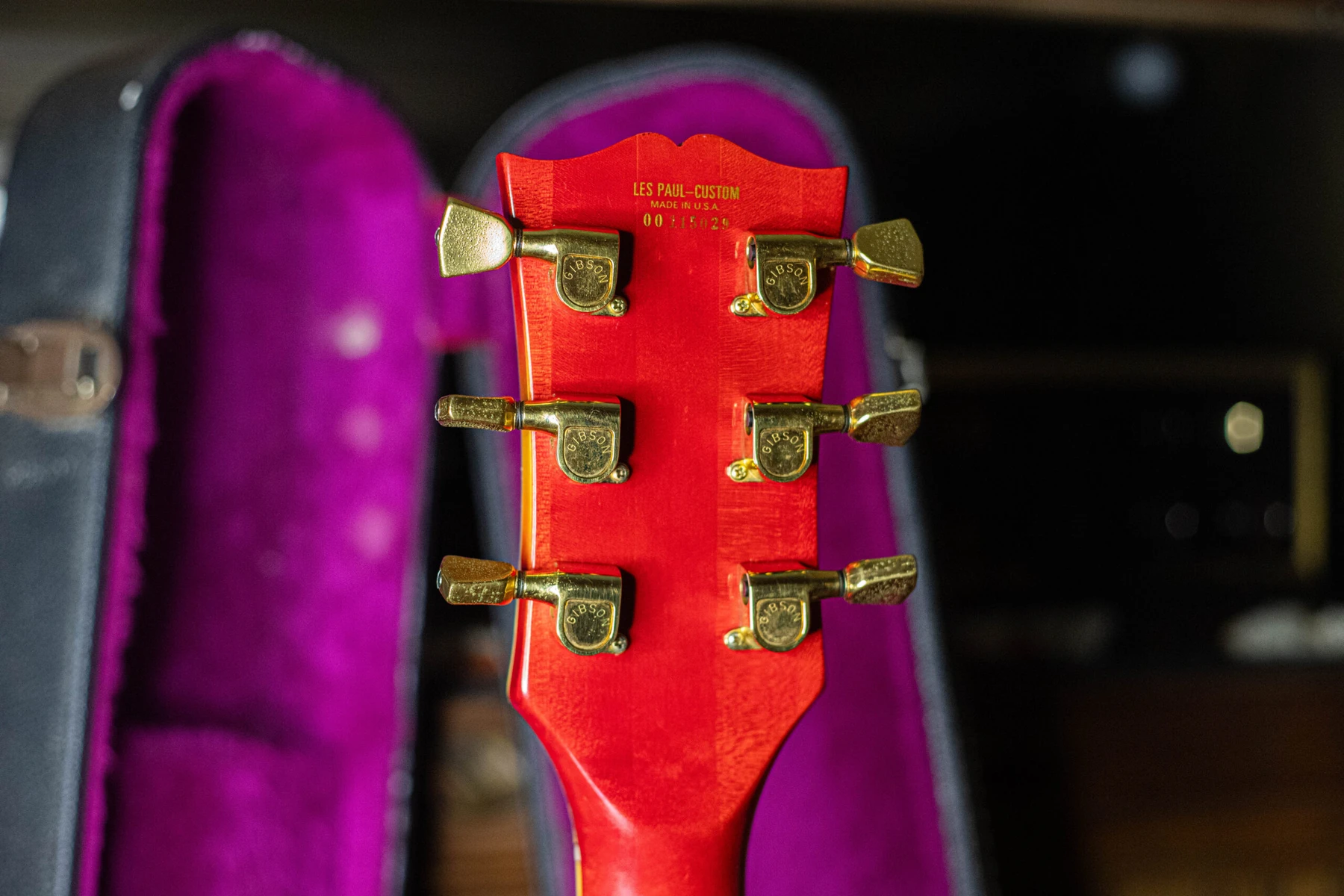
00115029 appears in gold with the model name. In this decal system, the 00 prefix points to 1976. Do not apply the later impressed-serial formula.
| Serial block | Possible year(s) |
|---|---|
| 000001 to 099999 | 1970 transition / 1973 |
| 100000 to 199999 | 1970 to 1975 |
| 200000 to 299999 | 1973 to 1975 |
| 300000 to 599999 | 1974 to 1975 |
| 600000 to 699999 | 1970 to 72 or 1974 to 75 |
| 700000 to 799999 | 1970 to 1972 |
| 800000 to 899999 | 1973 to 1975 |
| 900000 to 999999 | 1970 to 1972 |
| Prefix | Year | Look for |
|---|---|---|
| 99 | 1975 | Decal |
| 00 | 1976 | Decal |
| 06 | 1977 | Decal |
A 99-prefix can resemble a 1990s modern number. The physical decal is the deciding clue.
Check the physical features and hardware guide alongside these ranges. A claimed 1971 limited edition needs the model checks in the Flying V Medallion guide; a serial range alone does not identify that edition.
1977 to present
Most regular-production Gibson guitars use an eight- or nine-digit code. The first and fifth digits give the last two digits of the year. From 2014 to mid-2019, Gibson used a different format, explained below.
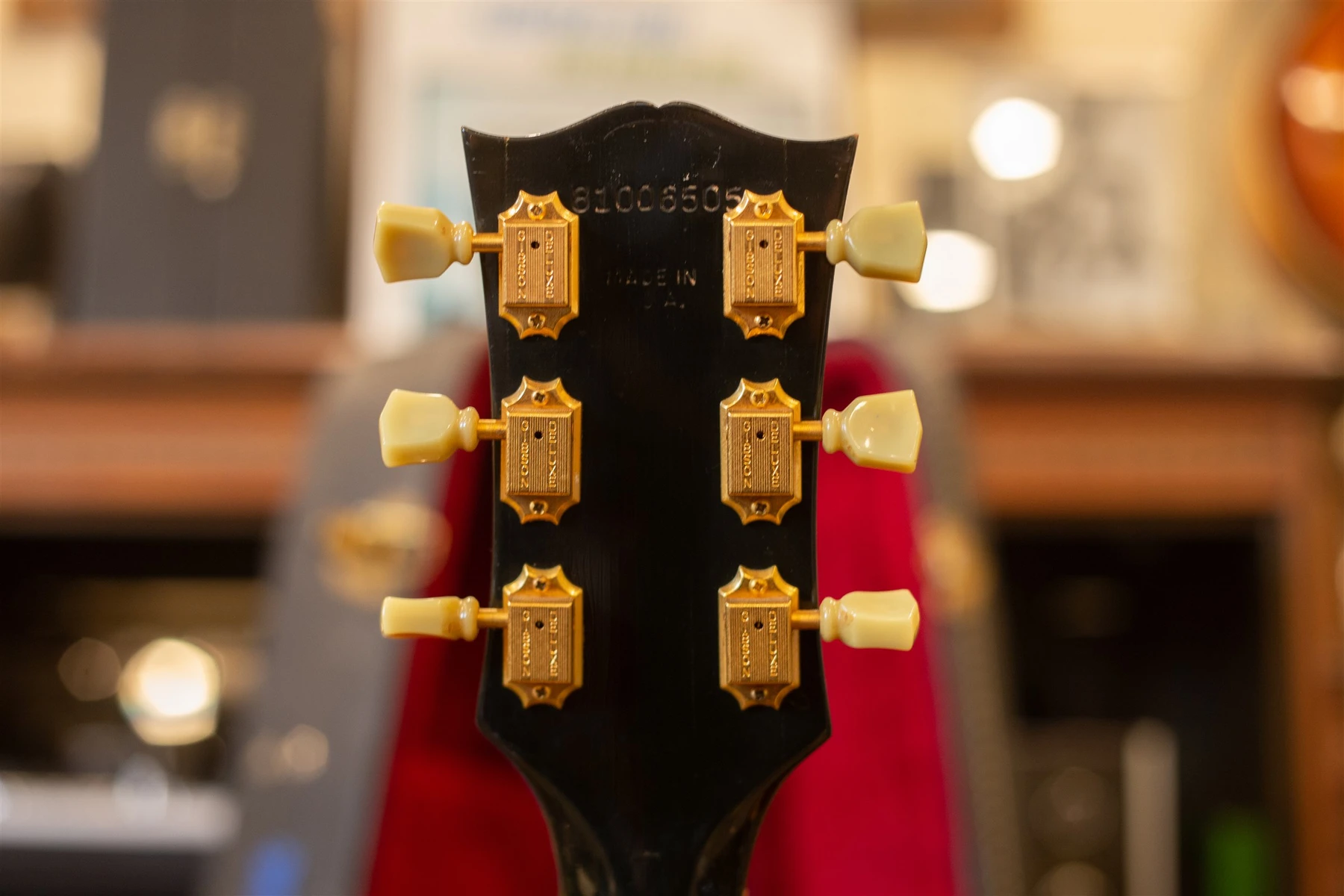
81006505 is an eight-digit example: digits 1 and 5 give 86, and digits 2 to 4 give day 100. On this J-200, that reads as 1986.
Format
Although Gibson operated in both Kalamazoo and Nashville from 1974 to 1984, this eight-digit serial format began in 1977. Within the format, Kalamazoo used rankings 001 to 499 and Nashville used 500 to 999. A serial ending in 501 does not mean it was the 501st guitar made in Kalamazoo. It identifies the first Nashville guitar stamped that day.
These worked examples appear in Gibson’s serial-number reference.
After Kalamazoo closed, Nashville continued using rankings 500 to 999 through 1989. The lower 001 to 499 block was left unused until the Bozeman system began. That is why 501 can mean the first Nashville instrument stamped that day rather than the 501st instrument overall.
Bozeman acoustic rankings start each day at 001. Gibson electrics can begin in the 300s, so the final three digits still combine a daily ranking with a plant designation.
Gibson USA expanded to YDDDYBRRR. The sixth digit is the batch number. Batch 0 begins the day, and after ranking 699 the batch number advances to 1.
After the model-year system below, Gibson USA returned to the nine-digit YDDDYBRRR format. This is a dated batch system, not a simplified eight-digit counter.
Gibson used a unique serial-number system for most of its production line during its centennial year, 1994. Most instruments from 1994 begin with 94 followed by six ranking digits. Exceptions include guitars made in early 1994, Custom Shop guitars and reissues. The special Centennial Collection uses a separate system below.
This nine-digit format is YYRRRRRRR: the first two digits give the model year and the remaining seven give the sequence. It does not encode a day of the year.
For example, 150000123 reads as 2015 model year, sequence 0000123. This example applies Gibson’s published model-year rule. A 2015-model instrument may have been built late in 2014, so the model year is not necessarily its calendar build year.
Choose the standard serial option in the decoder. Do not read digits 2 to 4 as a production day for this format. Custom Shop, Historic and Classic instruments need their own rules below.
Custom and Model-Specific
Confirm the model before reading these numbers. A reissue year identifies the guitar being recreated; it is not the year that reissue was built.
Reading the patterns: Y is a single year digit; YY is a two-digit year; M identifies the reissue model. DDD is the day of the year, counted from January 1. “Sequence” means the production or edition number, not a date.
Y sequence / YY sequence
1989: Four Digits
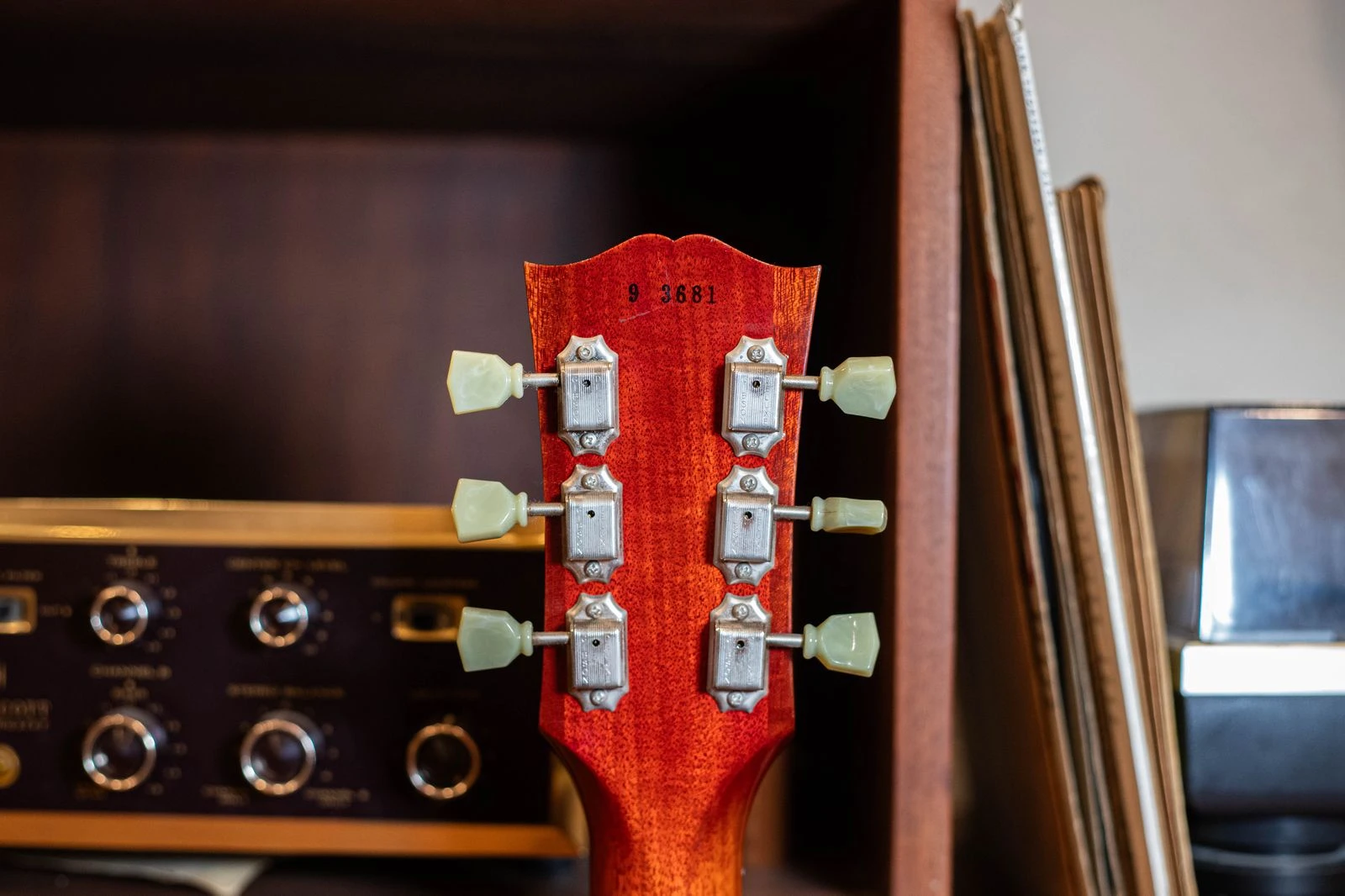
9 123 means 1989, sequence 123.
1989 to 1999: Five Digits
9 1234 can mean 1989 or 1999, sequence 1,234. Use features and provenance to determine the decade.
2000 to 2014: Six Digits
071234 means 2007, sequence 1,234.
2007 Variants: Nine Impressed Digits
027670593 reads as 2007, day 276, batch 0, ranking 593. See the exception below.
Number: Four digits beginning with 9 mean 1989. In the five-digit system, 9 1234 can mean 1989 or 1999, sequence 1,234. With six digits, the opening 00 to 14 means 2000 to 2014.
Dating: Confirm it is this Les Paul Classic model before using digit count. Use features and provenance to determine the decade. These rules do not apply to Historic reissues or original vintage Les Pauls.
CS + Y + sequence
CS + Year Digit + Sequence
CS102644 means Custom Shop, a build year ending in 1, sequence 02644. Matching records must establish the decade; the first two digits do not simply mean 2010.
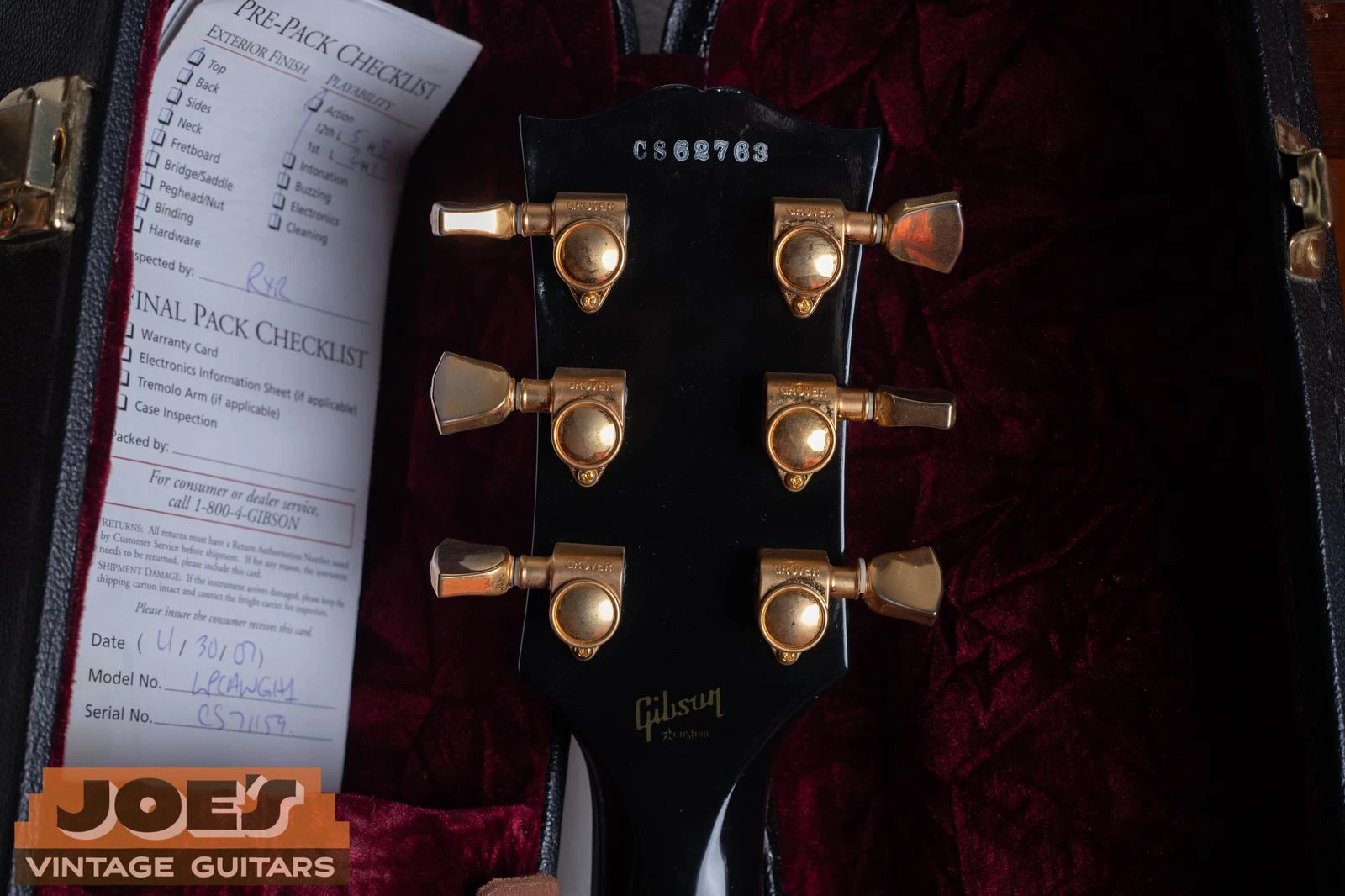
In CS62763, 6 is the last digit of the year. Any paperwork used for dating must match the headstock serial. Look closely here: the serial number on the paperwork does not match the one on the headstock, so it belongs to a different guitar. This should prompt further investigation into authenticity.
Number: The first digit after CS is the last digit of the build year. The rest is the production sequence, not a day or month.
Dating: Establish the decade from specs and provenance. A year digit of 1 alone cannot distinguish 2001 from 2011 or 2021. Longer sequences are supported, but serial length does not prove the decade.
M Y sequence
Model Digit + Year Digit + Sequence
On a Les Paul, 9 01234 identifies a 1959 reissue built in a year ending in 0, sequence 1,234. It does not choose between 2000, 2010 and 2020.
Number: The first digit identifies the model year being recreated. The second is the last digit of the year the reissue was built.
Dating: Use matching records to establish the decade. Five versus six total digits does not settle it; a 1959 reissue is not a guitar built in 1959.
Y sequence M / YY sequence M
Later System: Single Year Digit
Earlier System: Two Year Positions
030992 has the same earlier-format prefix for 2003 and 2013. A matching model and dated record are needed to select the year.
Number: Gibson publishes earlier two-position and later single-digit year systems with different model codes. Earlier prefixes 00 to 09 repeat on 2010s instruments; they do not always mean 2000 to 2009.
Dating: Confirm the exact model, numbering system and decade from matching records. For example, 030992 can fit 2003 or 2013. The claimed 2021 changeover is not a verified universal factory cutoff, so transition-era examples need individual checking.
1 Y sequence
Six-Digit Format
Number: Six digits total: an opening 1, a single build-year digit, then four sequence digits. The opening 1 does not distinguish the two reissue models.
Dating: Confirm the model from its label and paperwork, then establish the decade from matching records. The number alone gives only the year’s last digit.
A3 Y sequence
A3 + Year Digit + Sequence
Number: A3 identifies this reissue format. The next digit is the last digit of the build year, followed by three sequence digits, as in A38005.
Dating: Matching records must establish the decade. Numeric Memphis versions without A3 do not use this rule and need individual verification.
A8 Y sequence
A8 + Year Digit + Sequence
Number: A8 identifies the 1958 reissue format, not a 1958 build date. The next digit is the last digit of the build year.
Dating: Use matching factory or model records to establish the decade. The remaining sequence digits do not give a month or day.
A9 Y sequence
A9 + Year Digit + Sequence
Number: A9 identifies the 1959 reissue format, not a 1959 build date. The next digit is the last digit of the build year.
Dating: Confirm the exact ES model and decade from matching records. The sequence alone cannot separate build years ten years apart.
Y DDD Y sequence
Year Positions + Day + Sequence
Number: Digits 2 to 4 give the day of the year. The first and fifth positions carry year information, but the leading digit changed to 2 for the documented 2000s system.
Dating: With the model and 2000 to 2009 period confirmed, 20045002 reads as January 4, 2005, sequence 002, not 2025. Later decades need Gibson confirmation; this rule does not establish them.
The worked examples are published in Gibson’s serial-number FAQ. They establish the 1990s and 2000s readings shown here, not a rule for every later decade.
| Pattern | Applies to | What It Tells You and How to Date It |
|---|---|---|
| 94 + six digits | Many regular 1994 Gibson instruments | Number: Most instruments in Gibson’s 1994 production line begin with 94. All six remaining digits form the production ranking, not a date. Dating: The year is readable, but no month or day is encoded. Exceptions include guitars made in early 1994, Custom Shop guitars and reissues. Do not use the usual first-and-fifth-digit formula or the separate Centennial Collection rule. |
| CC + model + letter + sequence | Collector’s Choice | Number: The usual stamp has two model digits after CC, such as 01 or 09, followed by a letter and three sequence digits. The model identifies the guitar replicated, not the build year. Dating: No build year is encoded. Match the full number to factory records or paperwork that states this guitar’s build year; the model’s release year is not enough. |
| Artist prefix + edition sequence | Artist signature and limited runs | Number: The prefix and number usually identify an artist edition and its place in the run. Some editions instead use a standard serial or a year digit, such as the Frampton Special. Dating: Identify the exact edition first. For an undated run number, use matching build-year records; the artist’s name or an undated certificate cannot supply a date. See the artist table below. |
| 1894 to 1994 + issue suffix | 1994 Centennial Collection | Number: The four-digit number runs from 1894 through 1994 as a commemorative sequence. It is not the manufacture year. The suffix identifies the issue within the collection. Dating: Confirm the 1994 collection from the guitar and its paperwork. The suffix is not a dependable build month; use factory records for an individual production date. |
| Vintage-style stamp; Y + four digits on the regular 1983 to early 1993 Reissue | Guitar Trader and other early Les Paul reissues | Number: Guitar Trader headstock stamps imitate vintage numbers. On the separate regular 1983 to early 1993 Les Paul Reissue, the first digit is the actual build-year digit: 9 means 1989, while 3 can mean 1983 or early 1993. Dating: Confirm the exact reissue model first. Gibson-made Guitar Traders have a separate eight-digit cavity serial; only some other early reissues do. Nashville-made Leo’s examples may lack it. Use matching records when the model or decade is unresolved. |
| Eight-digit serial + separate four-digit edition | Heritage Standard 80 / 80 Elite; Les Paul 25/50 | Number: These can carry two numbers: a normal date-coded serial and a separate limited-edition number. The four-digit edition number does not encode a year. Dating: Use the eight-digit serial: digits 1 and 5 give the year; digits 2 to 4 give the day of the year. Keep the edition number separate and check the date against the model. |
| A to K + three digits; 1 + four digits | Early-1980s Heritage Korina Flying V; Explorer | Number: The reference lists A to K in a grouped Flying V, Moderne and Chet Atkins entry; it does not prove every letter occurred on Flying Vs. The Heritage Explorer uses 1 plus four production digits. Neither is a year code. Dating: Confirm the Heritage model and use matching factory records. If the guitar has a normal eight-digit date serial instead, decode that number; do not treat the short identifier as a date. |
Single year digits repeat. A Historic or CS year digit cannot establish the decade. Gibson’s earlier serial FAQ gives 7 5123 as a 1957 reissue made in 2005, so five digits do not mean “1990s.” Match the model and serial to dated factory records. A sale date or undated COA may not settle the build year.
Vintage-looking numbers need a model check. Gibson-made Guitar Trader reissues have a separate eight-digit serial on the control-cavity rim, but other early reissues do not all have it. The regular 1983 to early 1993 Les Paul Reissue instead uses its first headstock digit as the build-year digit. Numeric Memphis 1963 ES-335 reissues and unlisted artist editions still need individual verification.
| Artist or edition | Documented examples | Date information |
|---|---|---|
| Jimmy Page Number One | PAGE, JPP, or hand-numbered signed edition | No build date in the run number. The 2004 launch account reports public signed numbers 2 to 26, with 1 kept by Page; older serial FAQs say 1 to 25. Verify the number and provenance. Earlier Gibson USA Page models can have a normal serial. |
| Ace Frehley Custom | ACE plus sequence | The sequence does not date the guitar. Confirm the 1997 Custom edition and its records; USA and Budokan editions use different rules. |
| Slash Custom | SL plus sequence | No encoded year. Both the 1997 cranberry and 2004-introduced models used SL; identify the edition, then check its build records. |
| Joe Perry | JP or BONE plus sequence | JP identifies the 1996 Custom Shop trans-black edition; BONE identifies the Boneyard edition. Neither sequence encodes a build date. USA Perry models with normal serials use the standard date formula after model confirmation. |
| Peter Frampton | PF sequence; PF Y sequence on the Special | The Custom’s PF sequence has no date. On the Special, the digit after PF is a build-year digit; confirm the model and production period from matching records. |
| Billy Gibbons Pearly Gates | BG VOS; GIBBONS reported on an aged example | No build date in the edition sequence. Aged-and-signed guitars need individual verification; no universal signed prefix is established here. A signed COA does not mean the guitar itself was signed. Later Collector’s Editions use separate rules. |
| Duane Allman Cherry Sunburst | DA 59 sequence or ALLMAN sequence | No encoded build date; 59 refers to the replicated guitar, not the reissue’s manufacture year. Use matching build records. Hot ’Lanta is a separate run. |
| Eric Clapton Beano | EC, CLAPTON, or Eric Clapton # plus number | The prefix and number identify the VOS, aged or signed edition and sequence. No build year is encoded; use matching build-year records. |
What counts as dating evidence? Look for factory paperwork or Gibson confirmation that matches the full serial and states the build year. A certificate of authenticity (COA) may identify the edition without dating it. An inspection, shipping or sale date is not automatically the manufacture date. If no build-year evidence exists, leave the exact year unresolved.
These are documented patterns, not an authenticity test or a list of every special run. If your model is not listed, keep the complete prefix and compare the guitar, labels and matching paperwork. The tool labels a year you supply from a record separately from a year decoded from the number.
Confirm the model against the SG family, Les Paul family or ES-335, ES-345 and ES-355 dating guide before treating a vintage-looking stamp as an original production date.
Further Reading
Use these focused articles after choosing the main model, parts or features guide above.
Common Questions
Questions about value, player-grade condition, repairs or selling belong in the Sell My Gibson Guitar guide.
Yes. A serial number can be copied, reused, altered or applied to a refinished instrument, and a copied number can appear on a counterfeit guitar. A valid-looking number does not prove authenticity. Construction, hardware, electronics, finish and provenance all need to agree.
Some older Gibson instruments do not have a serial number. Look for a Factory Order Number stamped or written directly on bare wood inside the body. A FON can help date the production batch, but it is not the same as a serial number.
Usually not. A serial number may identify a production period, but it usually does not distinguish a Les Paul Standard from a Custom, Junior or another model. Use the guitar’s construction, pickups, hardware, finish and factory records to identify the model.
Gibson reused serial ranges, and single build-year digits repeat every decade on many reissues and Custom Shop models. Confirm the model and numbering system first, then use matching dated paperwork when the decade remains unresolved.
No. Gibson’s earlier serial FAQ gives the five-digit Historic example 7 5123 as a 1957 reissue made in 2005. Do not apply the Les Paul Classic digit-count rule to a Historic reissue.
Usually it identifies the model or edition sequence, not the manufacture date. Some artist models use standard serials or a year digit, so confirm the exact edition. An undated COA or a model’s release year may not date the individual guitar.
Common locations include an interior paper label, an ink stamp on the back of the headstock, or a number pressed into the headstock wood. Older acoustics may also have a FON stamped inside the body.
A modern serial uses digits 2 to 4 as the day of the year. Values outside 001 to 366 usually mean the number was entered incorrectly or the guitar uses a different system.

Still unsure?
Send clear photos of the front, back, headstock, number, electronics, and hardware for a no-obligation appraisal.
Get a free appraisal →