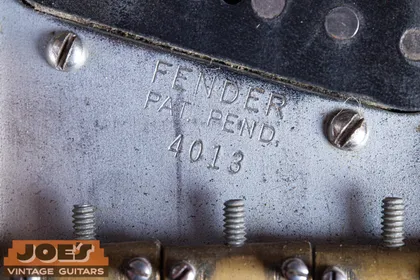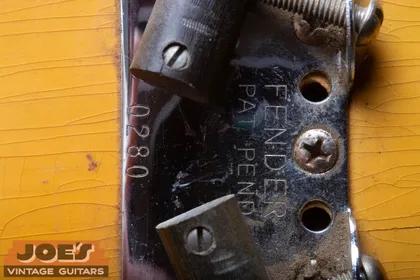
Bridge Plate: Telecaster
Stamped into the metal bridge plate where the strings anchor. You'll see this on the earliest Broadcasters, No-Casters, Telecasters, and Esquires.
1950 – 1954
Free Tool · Joe's Vintage Guitars
Decode any Fender guitar or bass serial number. American, Mexican, Japanese, and Custom Shop, 1950 to present.
Last reviewed by Joe, May 2026Step 1: Where is the serial number?
Where is the V-prefix serial located?
Where is the R-prefix serial located?
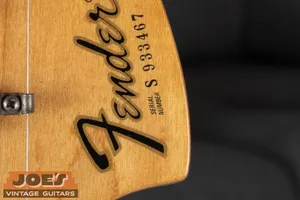
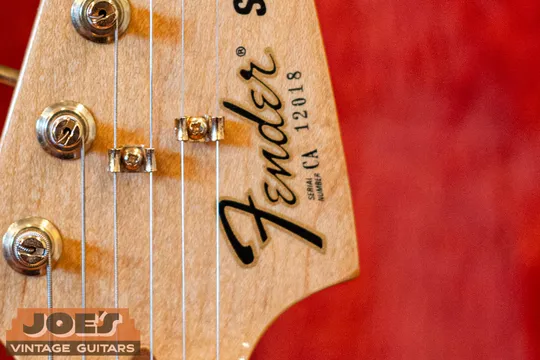
Where is the S-prefix serial located?
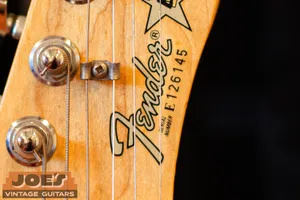
What does the back of the neck heel say?
Where is the L-prefix serial located?
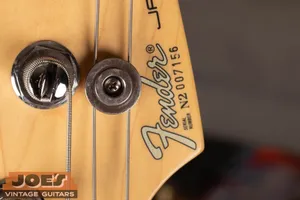
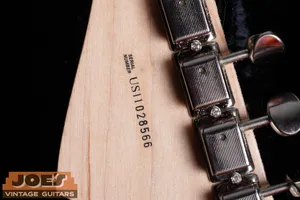
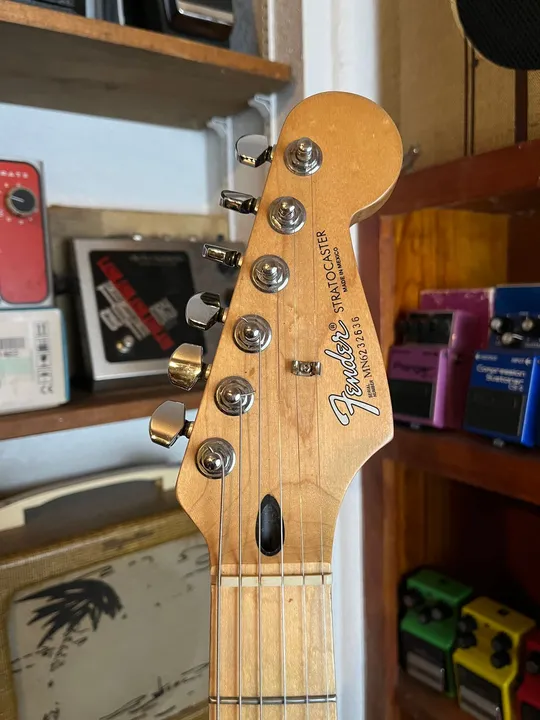
Where is the N-prefix serial located?
What does the back of the neck heel say?
Serial number ranges are estimates. Fender production was rarely perfectly sequential. For a precise appraisal or help selling your guitar, contact Joe's Vintage Guitars. Call or text 602-900-6635, or contact us online.
🔍 Cross-date your guitar for a more precise year
We couldn't automatically decode that serial number. Some older or rare Fenders need a hands-on look. Joe's Vintage Guitars can help. Call or text 602-900-6635, or contact us online.
🔍 Try cross-dating manually
Date any Fender guitar or bass, from the 1950 Broadcaster bridge plate stamps to current US-prefix serials. Covers American, Mexican, Japanese, and Custom Shop instruments. Use the charts and authentication checks below to pin down the year, factory, and originality of your instrument.
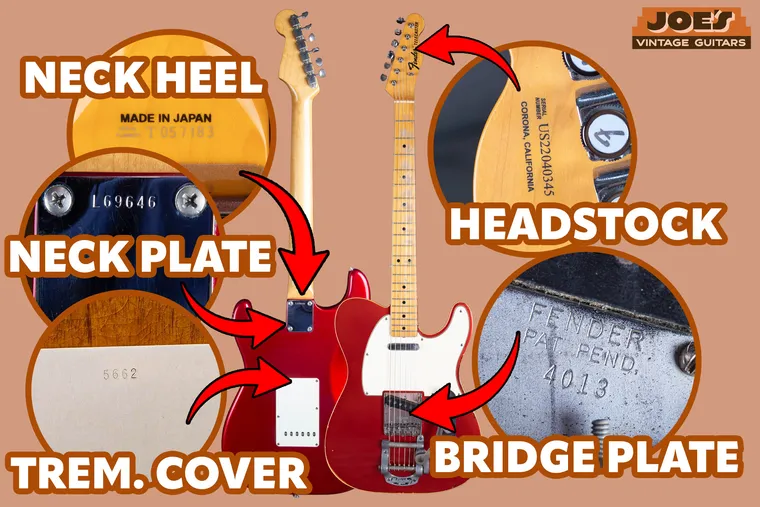
Before you can decode a Fender serial number, you've got to find it. Six different spots are possible depending on when your guitar was built, and the location itself narrows down the era before you even read the digits.
Stamped into the metal bridge plate where the strings anchor. You'll see this on the earliest Broadcasters, No-Casters, Telecasters, and Esquires.
1950 – 1954
Leo Fender's first electric bass, released in October 1951, also carried its serial on the bridge plate. It ran on a separate numbering sequence from the guitar lineup.
1951 – 1954
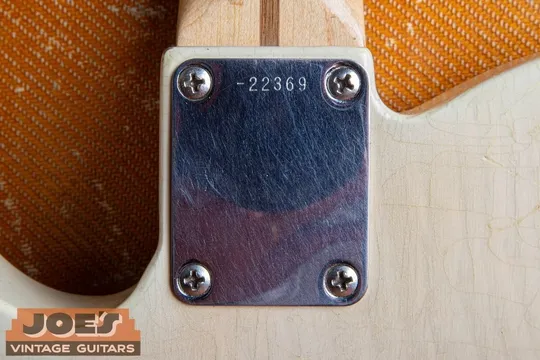
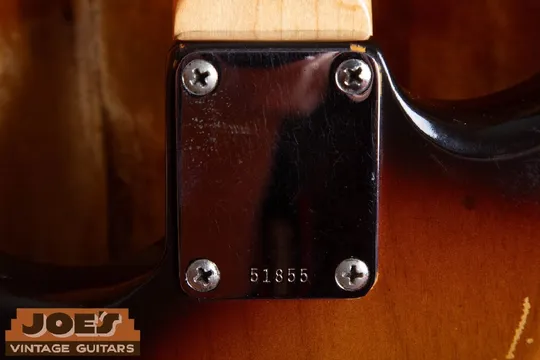
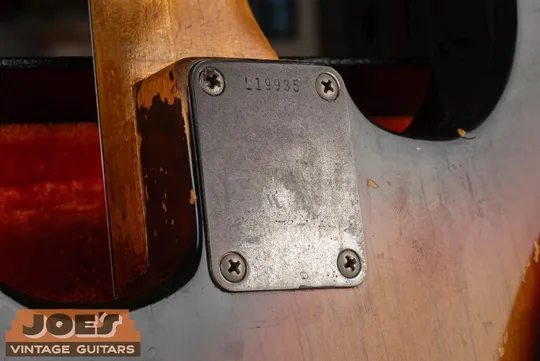
Flip the guitar over and look at the chrome plate where the neck bolts on. The number is stamped into the metal, sometimes near the top edge and sometimes near the bottom. This spot covers the widest stretch of the classic vintage era.
1955 – 1976
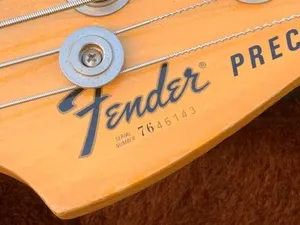
Sits right below the Fender logo on the face of the headstock. Either ink-stamped or printed as part of the decal itself. Standard placement on Strats, Teles, and basses from the post-CBS era.
1976 – 1995
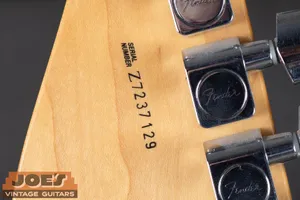
This has been the standard placement since 1996. A 'Made in USA' or country-of-origin stamp typically sits directly below the serial.
1996 – Present
The very earliest Stratocasters had the serial stamped into the plastic tremolo cavity cover on the back of the body. Only a handful of known examples exist, so this one shows up rarely.
1954–1955 (Early Strats Only)
Some Japanese-made Fenders carry the number on the back of the neck where it meets the body. You'll have to pull the neck off to see it.
Japanese Models, 1982 – Present
If your guitar has no serial number in any of these spots, you're likely looking at a heavily modified parts build, a guitar where the stamp has worn down past legibility, or an instrument that isn't a genuine Fender production piece. Send Joe some photos before drawing any conclusions: contact the shop directly.
Fender ran different serialization systems through different eras of the company's history. The timeline below maps the key periods, starting with Leo Fender's original Fullerton factory, moving through the CBS corporate years, and continuing into modern production.
On Fender's earliest electric instruments, the serial was stamped right onto the bridge plate. That covers the original Broadcaster, No-Caster, Telecaster, Esquire, and early Precision Bass. These are the rarest and most valuable Fenders ever made. Dating one from the bridge plate serial alone is difficult, so always cross-reference with neck heel dates, pot codes, and hardware features.
The Broadcaster came out in 1950, was briefly rebranded as the "No-Caster" in early 1951 after a legal dispute with Gretsch over the name, and became the Telecaster by mid-1951. The Esquire is the single-pickup variant. All three share the same serial sequence.
| Serial Range | Year(s) | Notes |
|---|---|---|
| 0001 – 1300 | 1950–1952 | Broadcaster / No-Caster / Early Tele |
| 1300 – 3000 | 1951–1954 | Telecaster name established ~mid-1951 |
| 3000 – 5000s | 1952–1954 | Transition to neck plate approaching |
If your guitar has its original Blackguard pickguard (black Bakelite), brass bridge saddles, and a "No-Caster" headstock decal (Fender logo with no model name underneath), you may be holding one of the rarest instruments in all of guitar collecting. The headstock decal is the first thing counterfeiters fake. Check it under magnification for proper aging and a raised waterslide edge consistent with genuine application. See our logo authentication guide →
Released in October 1951, this was the first commercially produced electric bass. The early ones had the serial on the bridge plate, running on its own sequence separate from the guitar lineup.
| Serial Range | Year(s) |
|---|---|
| 100 – 600 | 1951–1952 |
| 0001 – 0900 | 1952–1953 |
| 0900 – 2000 | 1954 |
From the mid-1950s into the early 1960s, Fender stamped 4- and 5-digit serial numbers onto the metal neck plate. This window covers nearly every landmark model: the original Stratocaster (1954), Jazzmaster (1958), Jaguar (1962), and Jazz Bass (1960). Serial ranges in this era overlap heavily, with a single number sometimes covering two or three years, so cross-referencing with other dating methods isn't optional.
Serial stamped at the top of the neck plate, the more common position
Same plate flipped over. Serial at the bottom edge, easy to miss at a glance.
| Serial Range | Year(s) | Era |
|---|---|---|
| 0001 – 8000 | 1954 | Pre-CBS |
| 6000 – 10000 | 1955 | Pre-CBS |
| 9000 – 16000 | 1956 | Pre-CBS |
| 16000 – 25000 | 1957 | Pre-CBS |
| 25000 – 30000 | 1958 | Pre-CBS |
| 30000 – 40000 | 1959 | Pre-CBS |
| 40000 – 58000 | 1960 | Pre-CBS |
| 55000 – 72000 | 1961 | Pre-CBS |
| 72000 – 93000 | 1962 | Pre-CBS |
| 93000 – 99999 | 1963 | Pre-CBS |
Fender pre-stamped large batches of neck plates and pulled them off the stack in no particular order during assembly. A guitar carrying serial 58,000 could legitimately be a 1960 or a 1961. The neck heel pencil date is far more reliable for pinning down a specific year, so always check both. How to read neck heel dates →
When Fender's sequential neck plate numbers got close to 99999, the factory tacked on an "L" prefix instead of rolling over to a 6-digit number. These guitars, built from late 1962 through 1965, cover the final years of the pre-CBS hand-built era and rank among the most collectible Fenders ever made. The L-Series straddles the CBS acquisition in January 1965, which means some L-prefix instruments are genuine pre-CBS and others are early CBS.
| Serial Range | Year(s) | Era |
|---|---|---|
| L00001 – L20000 | 1963 | Pre-CBS |
| L20000 – L55000 | 1964 | Pre-CBS |
| L55000 – L99999 | 1965 | Transition |
The most sought-after L-series guitar is arguably a slab-board Stratocaster with an L prefix. You're getting two of the most desirable vintage Fender specs in a single instrument. Check the headstock joint: thick, convex rosewood pushing up into the headstock equals a slab board. Find one and you've got a transitional piece that commands a serious premium. How to identify a slab board → | Always verify with pot codes →
After the CBS acquisition in early 1965, Fender brought in a new neck plate with a large stylized "F" logo and a 6-digit serial number. This system stayed in place until 1976, when Fender moved serials to the headstock. F-plate guitars are easy to spot: big headstocks on the Strats from 1966 onward, CBS-era styling throughout, and models like the Telecaster Custom and Coronado that only existed in this period.
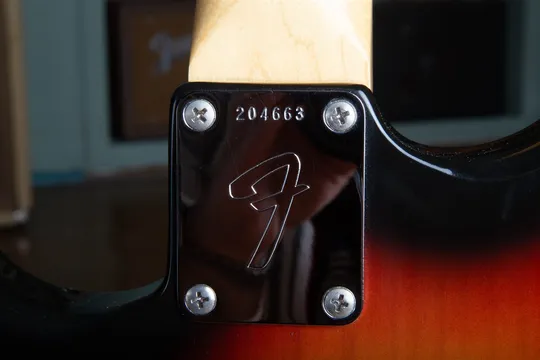
| Serial Range | Year(s) | Era |
|---|---|---|
| 100000 – 110000 | 1965 | Transition |
| 110000 – 200000 | 1966 | CBS Era |
| 180000 – 210000 | 1967 | CBS Era |
| 210000 – 250000 | 1968 | CBS Era |
| 250000 – 280000 | 1969 | CBS Era |
| 280000 – 300000 | 1970 | CBS Era |
| 300000 – 330000 | 1971 | CBS Era |
| 330000 – 370000 | 1972 | CBS Era |
| 370000 – 520000 | 1973 | CBS Era |
| 500000 – 580000 | 1974 | CBS Era |
| 580000 – 690000 | 1975 | CBS Era |
| 690000 – 750000 | 1976 | CBS Era |
The most common forgery in this era is a 1965 "Transition" guitar, an early F-plate with pre-CBS specs. Fakers grab a later CBS-era guitar and swap the plate over. Always verify that pot codes, neck stamp, and hardware all line up with a genuine 1965 build. A 1965 guitar with 1968 pot codes demands an explanation before you pay pre-CBS prices. How to decode pot codes → | Full hardware checklist →
When Fender launched its Vintage Reissue series in 1982, putting out faithful recreations of classic 1950s and 1960s Strats, Teles, and Precision Basses, they put a separate V-prefix serial on the neck plate. These are not vintage instruments. They're modern reissues built to replicate the original specs.
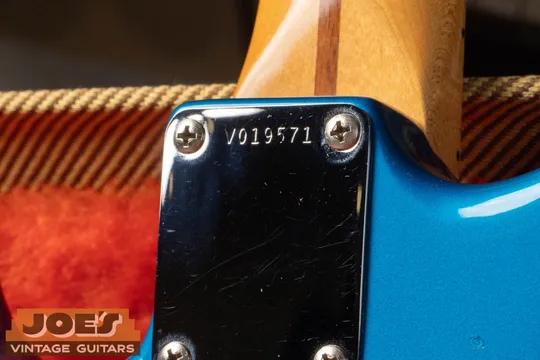
Vintage Reissue guitars are legitimately excellent instruments, but they sometimes get misrepresented as genuine vintage originals. The '52 Tele and '57 Strat reissues in particular are visually convincing. The fastest tell: the neck heel stamp will show a date in the 1980s or later, and pot codes from that era are a dead giveaway. Never pay vintage prices for a reissue.
The Fender Custom Shop, established in 1987, runs its own neck plate serial number system. Three prefixes show up most often, and one of them gets widely misunderstood across forums and listings.
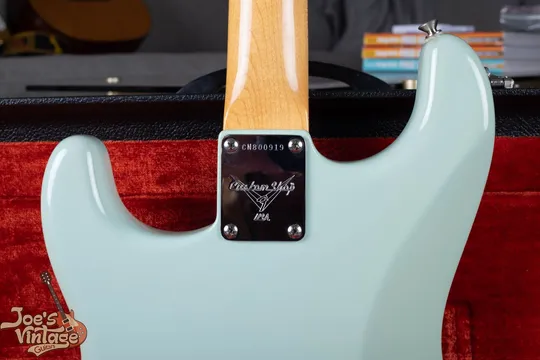
| Prefix | How to Decode | Notes |
|---|---|---|
| CN | Read the same as a standard N-prefix serial — C = Custom Shop, N = 1990s, first digit after CN = year | Custom Shop production from the 1990s |
| CZ | Read the same as a standard Z-prefix serial — C = Custom Shop, Z = 2000s, first digit after CZ = year | Custom Shop production from the 2000s |
| R | No reliable decode — see below | ⚠ Widely misunderstood — does NOT mean Relic or Reissue |
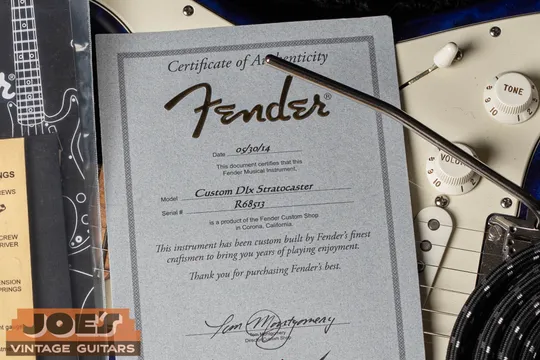
The R prefix turned up on Custom Shop instruments here and there with no consistent logic behind its assignment. It shows up on Custom Deluxe Stratocasters, Team Built instruments, and other models that are neither relics nor reissues.
There's no reliable dating scheme for R-prefix serials. To date or authenticate an R-prefix Custom Shop guitar you've got two options:
If you're buying a Custom Shop Fender with an R-prefix serial and the seller leans on "R = Relic" as a selling point or authentication argument, that's a red flag about the seller's knowledge, not the guitar itself. Always ask for the COA.
Starting in 1976, Fender moved serial numbers to the headstock and rolled out a letter-based decade coding system. The letter prefix indicates the decade of manufacture, and the first digit after the letter gives you the specific year.
Formula: [Decade Letter] + [Year Digit] + [Sequential Number]
S = Seventies • E = Eighties • N = Nineties • Z / DZ = 2000s • US = 2010s+
Examples: S958010 = 1979 | E212355 = 1982 | N975436 = 1999 | Z504999 = 2005
| Prefix | Decade | How to Decode | Example |
|---|---|---|---|
| 76XXXXX | 1976 | Starts "76" — overlap with early S-prefix | 76XXXXX = 1976 |
| S + digit | 1970s | S = 70s; 1st digit = year | S8XXXXX = 1978 |
| E + digit | 1980s | E = 80s; 1st digit = year | E4XXXXX = 1984 |
| N + digit | 1990s | N = 90s; 1st digit = year | N2XXXXX = 1992 |
76 Prefix = 1976
S Prefix = 1970s
E Prefix = 1980s
N Prefix = 1990s
🏅 Rare 1980s Prefixes
A small number of limited-edition CBS-era models used two-letter prefixes starting with C instead of the standard E. They follow the same decode formula (first digit after the prefix equals the year), but each one ties to specific collectible models:
CA prefix on a Gold Stratocaster, early 1980s
| Prefix | Digits | Era | How to Decode |
|---|---|---|---|
| N | 6 | 1990s | 1st digit after N = year. N2XXXXXX = 1992 |
| Z | 6 | 2000s | 1st digit after Z = year. Z2XXXXXX = 2002 |
| US | 8 | 2010s–2020s | First 2 digits after US = year. US10XXXXXX = 2010 |
| JD | 8 | 2010s Japan | JD = Japan Dyna; 1st 2 digits = year. JD11XXXXXX = 2011 |
Z Prefix = 2000s
US Prefix = 2010s–Present
Fender has manufactured guitars in Japan since 1982 and in Mexico since 1990. Both factories use distinct serial formats from American production, and the prefix letters tell you the country of origin.
| Prefix | Era | How to Decode |
|---|---|---|
| MN | 1990s | M = Mexico; N = 90s; 1st digit = year. MN0XXXXX = 1990 |
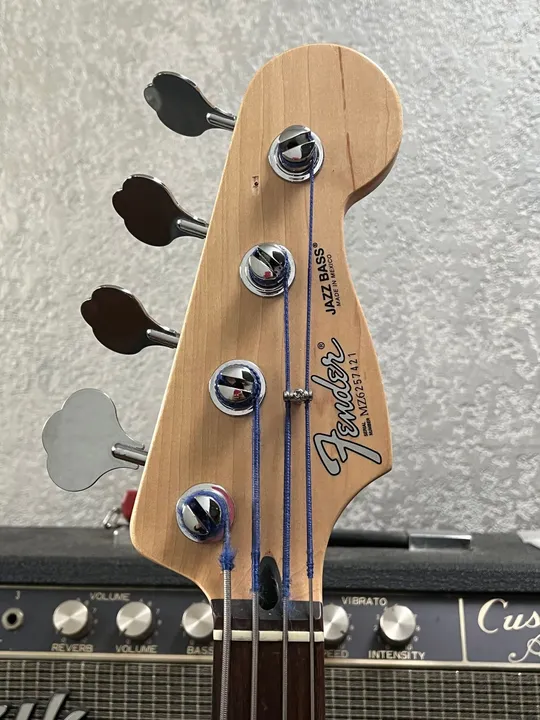
| MZ | 2000s | M = Mexico; Z = 2000s; 1st digit = year. MZ0XXXXX = 2000 |
| MX | 2010s–2020s | M = Mexico; X = 2010s–2020s; digits 1–2 after MX = year. MX12XXXXXX = 2012, MX23XXXXXX = 2023 |
MN Prefix = Mexico 1990s
MZ Prefix = Mexico 2000s
These guitars are dated by their letter prefix, with each letter corresponding to a production year range. Unlike the American headstock system, the letter doesn't encode a specific year digit; it just narrows the window.
| Code | Digits | Year Range |
|---|---|---|
| JV | 5 digits | 1982–1984 |
| SQ | 5 digits | 1983–1984 |
| A | 5 digits | Mid-1980s |
| B | 6 digits | 1985–1986 |
| F | 6 digits | 1986–1987 |
| H | 6 digits | 1988–1989 |
| I | 6 digits | 1989–1990 |
| J | 6 digits | 1989–1990 |
| K | 6 digits | 1990–1991 |
| L | 6 digits | 1991–1992 |
| M | 6 digits | 1992–1993 |
| O | 6 digits | 1993–1994 |
| P | 6 digits | 1993–1994 |
| Q | 6 digits | 1993–1994 |
| S | 6 digits | 1994–1995 |
| T | 6 digits | 1994–1995 |
| U | 6 digits | 1995–1996 |
| V | 6 digits | 1996–1997 |
| N | 6 digits | 1995–1996 |
The "Crafted in Japan" label replaced "Made in Japan" in the late 1990s. The same letter prefix dating system applies.
| Code | Digits | Year Range |
|---|---|---|
| A | 6 digits | 1997–1998 |
| B | 6 digits | 1997–1999 |
| O | 6 digits | 1997–2000 |
| P | 6 digits | 1999–2002 |
| Q | 6 digits | 2002–2004 |
| R | 6 digits | 2004–2005 |
| S | 6 digits | 2006–2008 |
| T | 6 digits | 2007–2010 |
| U | 6 digits | 2010–2011 |
The earliest Japanese Fenders, the JV-series built from 1982 to 1984, are exceptional instruments put together to incredibly tight tolerances. They came out of the Fujigen factory in Matsumoto during a period when Fender USA quality had dropped to a low point, and by many accounts the Japanese factory was outperforming Fullerton. A clean JV-series Strat or Tele is a serious collector piece in its own right.
Serial numbers are a starting point, not a verdict. The most common mistake buyers make is trusting a serial number without actually examining the instrument in front of them. This section walks through each major authentication checkpoint.
Original Fender serial numbers were applied with a high-pressure mechanical press that physically displaced the metal and created a subtle bulge around each digit. Hold the plate at a shallow angle under a lamp and look for chrome rising around the perimeter of the stamped numbers.
Modern counterfeits typically use laser etching, which is a removal process that leaves perfectly flat, clean edges with zero raised material. If the numbers look printed on top of the chrome rather than pressed into it, treat that as a serious red flag.
At the shop, I keep a jeweler's loupe sitting right by the workbench for exactly this reason. Under 10x magnification, the difference between a genuine mechanical stamp and a laser etch is unmistakable. The real stamp shows micro-abrasions in the chrome around the impact zone where the material was physically stressed. A laser etch is surgical and clean in a way old metal just isn't. Also check the headstock logo while you're at it →
On genuine pre-CBS Fenders from the 1950s and early 1960s, the headstock decal was applied as a waterslide transfer on top of the lacquer, not buried under a clear coat. Run your fingernail very lightly across the logo and you should feel a distinct raised edge. Authentic examples also show silvering, hairline checking, and sometimes slight edge lifting at the corners.
By late 1967 and into the 1970s, Fender started spraying clear lacquer over the decal. If a claimed "1962 Strat" headstock feels glass-smooth and the logo is completely buried under clear coat with no raised edge, you're likely looking at a refinished neck or a post-1967 replacement.
Don't touch the decal aggressively, you can damage an original. A very light pass with the pad of your finger is all you need. Also check the patent numbers printed below the logo, since they changed almost year-by-year on pre-CBS Fenders. Cross-reference the numbers on yours against known examples from the same year online. See the full Spaghetti → Transition → CBS logo guide →
On a genuine, un-molested vintage Fender, 60+ years of exposure affects every metal component the same way. The oxidation on the tuner housings should roughly match the bridge, pickup covers, strap buttons, and neck plate. No single piece should look dramatically newer or older than the rest.
The most sophisticated fakes get the individual parts right but get the relationships between parts wrong. A 1960 Stratocaster that's actually been played for 65 years will have wear patterns that follow the grip of a real human hand. If everything looks "correctly aged" but the wear doesn't follow how someone would actually hold and play the guitar, something's off. Run through the full hardware checklist →
| Feature | Pre-CBS (Pre-1965) | CBS Era (1965–1981) |
|---|---|---|
| Tuners | Kluson Deluxe (nickel): No-Line → Single-Line → Double-Line | F-Style by Schaller (chrome, 'F' on housing) from ~1968 |
| Fretboard Dots | Clay / fiberboard (dull, off-white/tan) until late 1964 | Pearloid (bright, shimmery, marbled) from late 1964 |
| Strat Saddles | Stamped steel with 'FENDER PAT. PEND.' on each saddle | Die-cast zinc block saddles (unbranded, thick) from ~1971 |
| Rosewood Board | Slab board (thick, flat bottom) 1959 – mid-1962 | Veneer / Round-Lam (thin, curved) from mid-1962 |
| Pickguard | Cellulose Nitrate, ages to mint green. Single-ply Bakelite on Tele | PVC (stays white/cream) from late 1964 |
| String Tree | Round disc until mid-1956; butterfly wing from mid-1956 | Butterfly / reel style through CBS era |
| Logo | Spaghetti (thin) until early 1964; Transition (bold gold) mid-1964–1967 | CBS / TV logo (heavy black) from 1968 |
| Finish | Nitrocellulose lacquer, thin finish that checks, crazes, and ages with the wood | Polyester/polyurethane from ~1968, thick and plastic-feeling |
| Headstock Size | Small 'pre-CBS' headstock on Strat/Tele | Enlarged 'CBS' headstock on Strat from 1966 |
Serial numbers give you a range. Advanced dating methods give you a date. This section covers the secondary dating techniques pros use, including neck heel stamps, pot codes, hardware transitions, and finish chemistry.
Almost every Fender guitar made before 1970 has a date written or stamped on the heel of the neck. These dates are the single most reliable way to date a vintage Fender. They were applied by the individual workers who built the neck, not assigned administratively from an office. A neck stamped "4-63" was finished in April 1963, period.
Written in pencil directly on the heel. Format: Month – Year. So "5-57" reads as May 1957. Sometimes the worker's initials follow the date.
Ink stamps encode more information. The format: [Model code] [Month][Year][Neck width]
Example: 1APR63B = April 1963, standard B-width neck.
The neck date and serial number should be within a few months of each other on an original, unmodified instrument. If the neck date reads 1961 but the serial number dates to 1964, you've got three possibilities: the neck was a leftover from a previous production run (common, since Fender kept parts in bins), the neck got replaced at some point, or something was misidentified. A documented "transitional" build where an older neck was used on a newer body is still 100% original. The documentation just makes it interesting, not suspicious. Cross-check with pot codes → | And body dates →
Fender guitars from the 1950s and early-to-mid 1960s often have a written date on the body itself, applied by the worker who routed it or sprayed the finish. This records when the body was completed, which could be weeks or months before final assembly.
Ink stamp in the neck pocket of a 1956 Telecaster
Interior cavity showing period-correct wiring and pencil dates
Body dates on Stratocasters get overlooked all the time because they're hidden under the tremolo back plate. On a claimed 1959 Strat, the body date should read sometime in 1958 or early 1959, since bodies were prepped weeks to months ahead of assembly. If the body date is from 1962, the body got replaced at some point. That doesn't make it a bad guitar, but it's a different guitar than a 100% original 1959, and the price should reflect that. Compare with the neck heel date →
Potentiometers (the volume and tone controls) are stamped with manufacturer and date codes that encode the year and the specific week of manufacture. They're nearly impossible to fake without complete replacement, which makes them one of the most reliable dating tools you've got.
| Code Format | How to Read | Example | Meaning |
|---|---|---|---|
| 3-digit | 1st digit = last digit of year; digits 2–3 = week | 632 | Week 32 of 1956 |
| 4-digit | Digits 1–2 = last 2 digits of year; digits 3–4 = week | 6243 | Week 43 of 1962 |
Full example: A pot stamped 304 6243 was made by Centralab in the 43rd week of 1962. The guitar was assembled no earlier than late October 1962, and typically a few weeks to months after that.
Stackpole pot with date code
Pot code breakdown diagram
CTS pot code example
The golden rule of pot codes: they give you the earliest possible assembly date, not the exact one. A pot made in week 32 of 1959 could have sat in Fender's parts bin for three months before getting installed in a guitar. So if your pot says week 32, 1959, the guitar was built no earlier than August 1959, but could just as easily be from late '59 or early '60. If three pots read from early 1962 and one reads from late 1963, the late 1963 pot is a replacement. Majority rules. Compare with the neck heel date → | Also check pickup date codes →
Workers often wrote or stamped the date directly on the base of the pickup. The format is typically month/year or just the year.
A 3–6 digit stamp code where the last one or two digits indicate the last digit(s) of the year:
Pre-1969 pencil date on pickup base
Ink date stamp on 1960s pickup
1970s numeric pickup code
Vulcanized fiberboard, despite the name (it's not actual clay). Dull and porous, they absorb oils and grime over the decades and age to a dingy off-white, tan, or brownish color.
Bright with a distinct "swirly" marbled texture. They stay shiny after decades of playing because they don't absorb finger oils the way fiberboard did.
Large rectangular pearloid blocks on the flagship offset models starting in 1966. The quickest visual identifier of a post-1966 Jazzmaster or Jaguar.
Clay/fiberboard dots (1959–1964): dull, matte, often discolored
Pearloid dots (late 1964+): bright, shiny, marbled
Block inlays (1966+, Jazzmaster/Jaguar)
In early 1964, Fender actually changed the side dots on the neck from clay to pearloid before they switched the main fretboard dots. So on a neck from the first half of 1964, you might see dull clay main dots paired with shiny pearloid side dots. That's one of the sharpest authentication tells for the transition period.
Brass saddles (1950 – mid-1954): gold color, dull patina
Steel saddles (mid-1954 – 1958): silver, prone to rust
Every authentic 1950s and 1960s Stratocaster has stamped steel saddles with "FENDER PAT. PEND." clearly stamped into each one. In late 1971, CBS switched to die-cast zinc "block" saddles. They're thick, rectangular, and completely unbranded. That's arguably the fastest way to spot a CBS-era Strat from across the room.
Stamped steel saddles (1954–1971), "FENDER PAT. PEND." on each
Die-cast zinc block saddles (1971+): thick, unbranded rectangles
Pull out a pair of calipers and measure the Telecaster saddles. Original pre-mid-'54 brass saddles run roughly 5/16" diameter. The steel replacements settled at roughly 1/4". If someone shows you a "1952 Telecaster" with 1/4" brass saddles, those are modern replacements. Also: if the saddles don't have "FENDER PAT. PEND." stamped on them on a claimed 1960s Strat, they're probably not original. See Telecaster spec guide by year → | Stratocaster spec guide →
Fender used Kluson Deluxe tuners from 1950 through the mid-1960s, then moved to F-Style tuners (built by Schaller) from the CBS era onward.
1950 – Mid-1956. Back of the housing is completely smooth, no text or branding. Clean and minimal.
Mid-1956 – Late 1964. "KLUSON DELUXE" stamped in a single vertical line. The hallmark of the Golden Era.
Late 1964 – 1967. Words split into two parallel vertical lines. Seeing double-lines on a claimed '62 is a major red flag.
No-line Kluson underside: "PAT. APPLD." = pre-1954 spec
Chrome-plated (not nickel like Klusons), with a large stylized "F" stamped on the back of the housing. The transition wasn't overnight. Guitars from 1965 through early 1967 turn up with either type.
Before 1954, many no-line Klusons were stamped "PAT. APPLD." on the underside of the casing. By 1954, that changed to a full patent number. Finding "PAT. APPLD." tuners is a strong indicator of a pre-1954 build. Also worth knowing: original Klusons are nickel-plated, so they develop a silvery-grey tarnish over time. F-Style Schaller tuners are chrome-plated, so they stay brighter and more reflective. A "bluish" chrome shine that doesn't tarnish the way old silver does means you're looking at F-Style hardware. Full pre-CBS vs CBS hardware checklist →
Spaghetti logo (1950 – early 1964): thin elegant script
Transition logo (mid-1964 – 1967): thicker, bolder gold-foil
CBS / TV logo (1968 – 1980s): heavy black with thin gold outline
Don't just look at the font style. Check the patent numbers printed below the logo. The number of patents listed changed almost year by year on pre-CBS Fenders. A claimed 1962 Strat should show the correct patent numbers for that exact year.
Up until mid-1956, Telecasters, Esquires, and early Precision Basses came with "Round Top" knobs that had a rounded crown and coarse, heavy knurling. Made of Bakelite. In mid-1956, Fender moved to flat-top skirt knobs with finer knurling.
Up until the end of 1954, Fender used a simple round "barrel" style switch tip. In late 1954, that changed to the "Top Hat" shape that's still on Telecasters today.
On original pre-1955 round barrel tips, many were manufactured by Daka-Ware in Chicago. Flip the tip over and look for that branding molded into the bottom. If it's there, you've found yourself a Holy Grail original part. Modern reproduction round tips are almost always blank and made of softer ABS plastic that feels "slicker" in the hand. Original Bakelite barrel tips have a harder, ceramic-like feel and are noticeably heavier for their size.
Round string guide (pre-mid-1956)
Butterfly string tree (mid-1956 onward)
Thick black single-ply guard. No visible layers on the edge. Heavy and hard to the touch. The term "Blackguard" literally comes from this pickguard.
White-Black-White construction, white when new. The mint green color develops over decades as the nitrate undergoes chemical change. Can have a faint vinegar or camphor smell to it.
Much more chemically stable. Doesn't turn green. May parchment or yellow slightly over time but never reaches the classic mint-green hue of nitrate.
Nitrate "mint green" guard (1959–1964)
Tortoise-shell nitrate (Jazzmaster/Jaguar)
White PVC guard (late 1964+): never turns green
If you're uncertain whether a guard is original nitrate, the smell test works. Original cellulose nitrate pickguards often have a distinct chemical smell, musty and acidic, often likened to vinegar. Modern plastic guards have no such smell at all. It's not 100% reliable on guards that have been sealed in a bag for years, but on an untouched vintage guitar it's a surprisingly useful tool.
Leo Fender's original design: a one-piece maple neck with frets cut directly into the maple itself. No separate fretboard at all.
A thick, flat-bottomed slab of rosewood glued directly onto the maple neck. Look at the headstock joint right above the nut and you'll see the rosewood form a thick, convex curve.
A thinner veneer board with a curved bottom matching the neck radius. At the headstock, the rosewood line looks much thinner and flatter.
Slab board (1959–mid-1962): thick, convex rosewood at headstock
Veneer board (mid-1962+): thin, flat rosewood at headstock
August 1962 is the magic month. Fender switched from slab to veneer boards mid-production that month, so you can find both types on guitars carrying August '62 neck stamps. A slab-board guitar with an August '62 neck date is a highly valuable transition piece.
Genuine old nitrocellulose almost always shows at least some crazing after 50+ years. If you're looking at a claimed vintage Fender with a thick, glassy, completely uncracked finish, you've got three possibilities: it's a polyester-era instrument (post-~1968), it's been professionally refinished at some point, or it isn't what it claims to be. Also worth knowing: "relic" finishes on modern instruments are artificially aged to mimic nitro checking. Genuine vintage checking follows the temperature history of the wood, while artificial checking tends to be more uniform or suspiciously concentrated in the obvious wear spots. How to check patina consistency → | Full era hardware checklist →
Fender offered custom colors from 1956 onward. Original custom color Strats command serious premiums in today's market. The most valuable colors (roughly in order): Shoreline Gold, Burgundy Mist, Surf Green, Sonic Blue, Daphne Blue, Sherwood Green, Foam Green.
Custom color authenticity is one of the most complex areas of Fender authentication. No single test is sufficient, and for any significant purchase, expert examination is practically a must. That said, two production methods leave useful physical evidence. Up until around 1962, Fender held bodies during painting by driving small nail holes into the pickup or control cavity areas. On a genuine pre-1962 custom color, these holes should be present and have no finish inside them (the nail was there when the paint went on). Around 1962, Fender switched to a paint stick method, screwing a rod into the neck pocket to hold the body during spraying, which eliminated the nail holes entirely. A paint stick guitar will often show a faint shadow or witness mark in the neck pocket where the stick was attached and masked the finish slightly. Neither feature alone confirms authenticity, and both can be faked. Always have a specialist examine a custom color Fender before paying a premium. Full patina consistency guide →
| Profile | Approx. Years | Description | Collector Notes |
|---|---|---|---|
| V-Shape | 1950–1957 | Pronounced V 'boat' ridge down center back. Aggressive and asymmetric. | Divisive but highly sought by early-era collectors. |
| Soft V / Transitional | 1956–1958 | V ridge softens considerably, beginning to round out. | Often considered the most comfortable neck Fender ever made. |
| Round C-Shape | 1958–1962 | Full, round C profile. Comfortable and balanced. | The neck most players think of as 'vintage Strat' feel. |
| Thin D-Shape | 1962–1965 | Noticeably flatter and thinner front-to-back. 'Fast' neck. | Great for players; slightly less collectible than earlier profiles. |
| CBS Chunky C | 1966–1971 | Inconsistent profiles, often thicker and chunkier. Quality variable. | Early CBS (1965–1967) often retains pre-CBS feel. |
| 3-Bolt 'Bullet' | 1971–1981 | 3-bolt neck joint, bullet truss rod adjuster on headstock. Medium C varies. | Generally least desirable era for collectors; some 70s Strats now appreciating. |
Up until summer 1955, Fender used flat pole piece pickups, with all six magnets sitting at the same height. In mid-1955, they switched to staggered poles to balance string-to-string volume. A Telecaster with flat poles is almost certainly a pre-mid-1955 build.
On early staggered pickups from mid-1955, the D-string magnet is the highest pole piece. If you're looking at a "staggered" pickup where the D-string pole isn't higher than the rest, you're looking at a replacement pickup or a non-period instrument. Get a ruler out, measure the pole heights, and compare the D to the others. This specific detail is something most people never bother to check. Telecaster pickup specs by year → | Stratocaster pickup specs by year →
Original Stratocaster pickup bobbins from the 1950s were wound on black bobbins. From the early 1960s onward, grey bobbins started showing up. Black bobbins are consistent with a 1950s build on a claimed early Strat. Grey bobbins on a supposed 1954–1956 example should prompt closer inspection before you pay early-Strat money.
Fender's pickup bobbin color shift went in the same direction across all models: black bobbins are earlier, grey bobbins are later. The exact switchover happened at different times on different models, but the direction is consistent across the lineup. Grey bobbins on a claimed very early example of any model should prompt closer inspection.
Jazzmaster pickups use a distinctive wide, flat single-coil design with flush/flat pole pieces, where the magnets sit level with the pickup cover surface rather than protruding. This design ran consistently across the entire production history. Fender never switched Jazzmasters to staggered poles the way they did with Telecasters and Stratocasters.
The key dating clue on Jazzmaster pickups is the bobbin back color:
Jaguar pickups use the same wide flat-coil design as the Jazzmaster and look visually very similar. The easiest way to tell them apart is that Jaguar pickups have a metal pickup surround/claw mounting them to the body, whereas Jazzmaster pickups sit in a floating mount in the pickguard. Unlike the Jazzmaster, the Jaguar did adopt staggered pole heights:
The same black vs. grey bobbin back dating rule applies: black backs indicate earlier production (1962–early 1960s), grey backs indicate later.
Jazzmaster and Jaguar pickups are among the most frequently swapped components on vintage offset guitars. Partly because they're easy to get to, partly because the market for "upgraded" pickups has driven a lot of replacement over the years. Always pull the pickguard on a claimed early example and check that the bobbin color, solder joints, and wiring cloth all match the claimed year. Original wiring cloth on pre-CBS Fenders has a specific braided texture that reproduction wire doesn't fully replicate. Cross-check with pot codes → | Jazzmaster model guide → | Jaguar model guide →
Each Fender model has its own changeover dates, specifications, and authentication points on top of the general info above. Use these guides alongside the serial charts and advanced dating methods for the most accurate identification.
Introduced Spring 1954 – Present
The most widely copied electric guitar ever made, and the most-forged vintage Fender. The earliest examples (1954–1955) are the rarest, since they used the tremolo plate serial before the system moved to the neck plate.
| Year Range | Key Specs | Authentication Notes |
|---|---|---|
| 1954–1955 | 1-piece maple neck, single-ply white guard, serial on tremolo plate, 2-tone sunburst, V-neck, flat-pole pickups (pre-mid-55), round string guide | Rarest Strats. Verify tremolo plate serial authenticity. Alder and ash body used interchangeably early on. |
| 1956–1958 | Staggered pole pickups (mid-55+), butterfly string tree (mid-56+), single-line Klusons (mid-56+), flat-top knobs (mid-56+) | Soft V to round C neck transition. Check pencil date on heel. |
| 1959–Mid-1962 | Slab rosewood board (mid-59+), clay dots, nitrate mint-green guard, round C neck, 3-color sunburst available (1958+) | Slab board Strats among the most collectible. Verify slab vs. veneer at headstock joint. |
| Mid-1962–1964 | Veneer rosewood board, clay dots (until late 64), thinner D-neck, mint green guard | Check side dot color: pearloid side dots appeared before the main dot change in early 1964. |
| Late 1964–1965 | Pearloid dots, transition logo, double-line Klusons, PVC white guard | Pre-CBS specs with post-CBS logo = valuable crossover. Verify pot codes agree. |
| 1966–1971 | Large CBS headstock (1966+), CBS/TV logo (1968+), F-Style tuners (~1968+), poly finish (~1968+), stamped steel saddles still used | Large headstock = instant visual tell. Poly finish doesn't check like nitro. |
| 1971–1981 | Die-cast zinc block saddles (1971+), 3-bolt neck joint (1971+), bullet truss rod adjuster on headstock | Block saddles = instant CBS-era ID. 3-bolt neck can cause neck pocket slop on worn examples. |
1950 – Present (Longest-Running Electric Guitar in Production)
The original Fender solid-body electric guitar, known as the Broadcaster (1950), No-Caster (early 1951), and Telecaster (mid-1951 onward). The Esquire is a single-pickup version. It's been in continuous production longer than any other electric guitar design in history.
| Year Range | Key Specs | Collector Notes |
|---|---|---|
| 1950–Early 1951 | Broadcaster name, black Bakelite guard, brass saddles, flat-pole pickups, serial on bridge plate, barrel switch tip, no-line Klusons | Broadcaster with headstock decal intact is extremely rare. 'No-Caster' = blank headstock between Broadcaster and Telecaster eras. |
| Mid-1951–1954 | Telecaster name, black guard (Blackguard era), brass saddles, serial moves to neck plate ~1954, barrel switch tip until late 1954 | 'Blackguard' Telecasters are the holy grail. Top hat switch tip begins late 1954. |
| Mid-1954–1956 | Steel saddles (mid-54), white guard (Whiteguard era), staggered pickups (mid-55+), round string guide until mid-56, round-top knobs until mid-56 | Whiteguard era begins. Flat vs. staggered pole pieces and saddle material are key dating tools. |
| 1956–1959 | Butterfly string tree, flat-top knobs, single-line Klusons, maple neck, single-ply white guard | Late '50s Teles are highly collectible. You get excellent playability paired with simpler, more affordable construction than a Strat. |
| 1959–1965 | Rosewood board option added (mid-59), slab then veneer transition (mid-62), clay to pearloid dots (late 64), mint green guard available | Rosewood-board Teles less common than maple variants; slab board examples especially valuable. |
| 1966–1981 | F-Style tuners (~1968), CBS/TV logo (1968), Telecaster Custom launched (1972), Telecaster Thinline (1969), poly finish (~1968) | CBS-era model expansions. Thinline and Custom are distinct models with their own collector followings. |
🔗 Read our dedicated 1952 Fender Telecaster Authentication Guide →
Introduced 1960 – Present
Introduced in 1960 as an upmarket companion to the Precision Bass. It featured an offset double-cutaway body, slimmer neck profile, two pickups, and originally stacked concentric controls. Early examples sit among the most collectible and valuable vintage Fenders out there.
| Year Range | Key Specs | Notes |
|---|---|---|
| 1960–1961 | Stacked concentric volume/tone controls (2 knobs), 3-saddle bridge with 'ashtray' cover, slab rosewood board, clay dots, offset body, single-line Klusons | Earliest Jazz Basses are extremely rare and valuable. Stacked concentric controls are unique to this period, and the hole pattern in the body is different from later versions. |
| 1962–Mid-1962 | Controls changed to 3-knob layout (2 volume, 1 tone), slab board still present | Control configuration changed in 1962. Verify 2-knob vs. 3-knob layout as a dating indicator. |
| Mid-1962–1964 | Veneer rosewood board, 3-knob layout, clay dots, single-line Klusons, mint green guard | The sweet spot for Jazz Bass collectors: pre-CBS, veneer board, excellent build quality. |
| Late 1964–1965 | Pearloid dots, double-line Klusons, transition logo, PVC white guard | Final pre-CBS spec changes. Crossover Jazz Basses are especially collectible. |
| 1966–1975 | CBS/TV logo (1968), F-Style tuners (~1968), bound fingerboard on some models, poly finish (~1968), 3-bolt neck (1975–1982) | Early CBS (1965–1967) retained pre-CBS feel. Quality variable post-1968. |
Introduced October 1951 – Present
Leo Fender's first electric bass, and the first one anybody produced commercially. The P-Bass went through more dramatic design changes in its first decade than almost any other Fender model.
| Year Range | Key Specs | Notes |
|---|---|---|
| 1951–1952 | Serial on bridge plate, one-piece maple neck, single-cutaway Telecaster-style body, black Bakelite guard, no-line Klusons, barrel switch tip | First-generation P-Bass looks very different from later versions. Telecaster-style single cutaway. Extremely rare. |
| 1953–1954 | Body contours added (double-cutaway begins in 1954), neck transitions to neck plate serial | 1954 was a major redesign year. The double-cutaway body profile got established here. |
| 1955–1957 | Anodized aluminum pickguard (1954–1959), maple neck, staggered pickups, split-coil pickup design introduced 1957 | Split-coil hum-cancelling pickup introduced in 1957, the design still used today. Pre-split-coil examples are single-coil and much rarer. |
| 1957–1959 | Split-coil pickup standard, anodized aluminum guard, single-line Klusons (mid-56+) | The 'classic' vintage P-Bass configuration: split coil, maple neck, anodized guard. |
| 1959–Mid-1962 | Slab rosewood board (mid-59), tortoise-shell or mint-green nitrate guard replaces anodized, clay dots | Slab rosewood P-Basses are highly prized. Anodized guard replaced by nitrate guard. |
| Mid-1962–1965 | Veneer rosewood board, clay to pearloid dots (late 64), mint green to white guard transition | Pre-CBS late-era P-Basses. Very playable and collectible. |
1958 – 1980 (original run)
Introduced in 1958 as Fender's top-of-the-line model, with an offset waist body, floating tremolo system, and a separate rhythm circuit. Originally marketed to jazz players, it ended up becoming a staple of surf, indie, and alternative rock instead.
| Year Range | Key Specs |
|---|---|
| 1958–1959 | First year. Anodized aluminum pickguard (gold), maple-only neck option, spaghetti logo, serials in 20000–30000 range, no-line Klusons |
| 1959–Mid-1962 | Slab rosewood board (mid-59), tortoise-shell nitrate guard replaces anodized (1959), clay dots, single-line Klusons |
| Mid-1962–1964 | Veneer rosewood board, clay dots, mint green or tortoise guard, L-series serial (late 62+) |
| 1965–1966 | Pearloid dots, transition logo, double-line Klusons, PVC guard. Jazzmaster kept the small headstock; no CBS large headstock here |
| 1966–1974 | Block inlays (1966), CBS/TV logo, F-Style tuners, bound neck on some models. Jazzmaster discontinued 1980. |
1962 – 1975 (original run)
Introduced in 1962 as Fender's most elaborate and premium offset model. It has a shorter 24" scale, 22 frets, an onboard string mute system, and individual string dampers. The most complex Fender ever built. Production ended in 1975 and resumed in 1986.
| Year Range | Key Specs |
|---|---|
| 1962–Mid-1962 | Slab rosewood board, clay dots, tortoise-shell nitrate guard, spaghetti logo, serials in 80000–90000 range |
| Mid-1962–1964 | Veneer rosewood board, clay dots, L-series serial, mint green or tortoise guard |
| Late 1964–1965 | Pearloid dots, double-line Klusons, transition logo, PVC guard, pre-CBS specs mostly intact |
| 1966–1975 | Block inlays (1966), CBS/TV logo, bound neck, F-Style tuners, poly finish (~1968), discontinued 1975 |
1964 – 1982 (original run)
Introduced in 1964 as a student-grade instrument with a shorter scale and simplified layout. Became a fixture in 1990s alternative rock when players like Kurt Cobain and Thurston Moore made it their own.
| Year Range | Key Specs |
|---|---|
| 1964–1965 | 22.5" scale, pre-CBS specs, spaghetti / transition logo, serial in L-series or early F-plate range, no competition stripes yet |
| 1966–1969 | Standard headstock (no large CBS headstock), pearloid dots, F-Style tuners gradually introduced, competition stripe finishes not yet standard |
| 1969–1982 | Competition stripe finishes (Red, Orange, Blue, Burgundy), CBS/TV logo, poly finish, 24" scale option. Discontinued 1982. |
Send Joe photos for a free, no-obligation identification and value estimate.
Beyond this guide, here are the most reliable resources for Fender serial number research:
Send photos to Joe for a free, expert identification and value estimate. In-person evaluations available in Mesa, AZ.
(602) 900-6635Fender maintains an official serial number lookup tool. Most reliable for post-1990 instruments.
serialnumberlookup.fender.com →Community-maintained database with broad coverage of Fender, Gibson, and other major brands.
guitardaterproject.org →Active community of Fender enthusiasts and experts who can help with identification questions.
thefenderforum.com →Joe's Vintage Guitars offers free appraisals and pays top dollar for quality vintage Fenders. No obligation, just send photos.
Have a vintage guitar to sell or a question? We’re here to help.